Skip to main content







By: Senior Crypto Analyst, Adam Taylor, CryptoLikeThis | Updated: April 29, 2026 | 8 min read
Two words come up constantly in crypto — centralized and decentralized. Every exchange, every wallet, every DeFi protocol gets described by one of these two terms, often without much explanation of what either actually means in practice.
Most beginner guides get this wrong in the same way: they explain the theory clearly enough, then leave you with no idea how it affects your actual decisions. This guide fixes that. By the end, you’ll understand not just what centralization and decentralization mean, but why the distinction directly affects whether you truly own your crypto — and what happens when a platform you trust runs into trouble.
One number to anchor the conversation: as of early 2026, total value locked (TVL) across decentralized finance protocols sits between $130–140 billion, according to DeFiLlama. That’s real capital operating entirely without banks, brokers, or central authorities. Decentralization isn’t a fringe experiment anymore — and understanding it is foundational to navigating crypto safely.
What Is Centralization?
Centralization means a single authority — or a small group — controls the system. Every decision, every transaction, every rule change flows through that central point. You either trust the authority running it, or you don’t participate.
Most of the financial infrastructure you’ve used your entire life runs on this model. Your bank decides when you can access your money, which transactions it approves, and what happens if it suspects unusual activity. It can freeze your account, reverse transactions, and share your information with government agencies when ordered to do so. You agreed to all of this when you signed up, even if you didn’t read the fine print.
That said, centralization isn’t inherently bad. In fact, it works well in many contexts. A bank’s customer support team can actually help you when something goes wrong. A centralized exchange can implement fraud protection, dispute resolution, and regulatory compliance in ways that a decentralized protocol simply cannot. Speed is also a real advantage — a decision that would require weeks of community governance voting in a decentralized system can happen in a single afternoon at a centralized organization.
Centralized systems — familiar and crypto-specific
| System | Who controls it | What that means in practice |
|---|---|---|
| Traditional banks | The bank and government regulators | Can freeze accounts, reverse transactions, report activity to authorities |
| Coinbase / Binance | The exchange company | Hold your private keys; can suspend withdrawals, comply with court orders, or go bankrupt |
| Social media platforms | Meta, X, TikTok | Can delete accounts, censor content, and monetize your data |
| Tether (USDT) | Tether Limited | Can freeze specific wallet addresses — and has done so dozens of times |
That last row is worth pausing on. USDT is the world’s largest stablecoin and a staple of crypto trading. Yet most people using it assume it behaves like a decentralized asset. It doesn’t — Tether Limited holds the ability to blacklist specific wallet addresses and freeze those funds entirely. As a result, there’s a centralized power sitting inside the crypto ecosystem that surprises many newcomers.
What Is Decentralization?
Decentralization means no single point of control. Instead, the system runs across thousands of independent computers — called nodes — each holding a copy of the same data and following the same rules. No single person or company owns the network. It cannot be unilaterally changed, and crucially, it cannot be shut down by any one authority.
Bitcoin is the cleanest example available. There is no Bitcoin company, no CEO, no board of directors, and no headquarters. The network runs on roughly 18,000+ nodes scattered across the globe. If one government banned Bitcoin tomorrow and seized every node within its borders, the network would consequently continue functioning on the remaining nodes in every other country. That’s what censorship resistance actually means in practice — not a marketing claim, but a structural reality.
Ethereum works on the same distributed principle — but it additionally introduced smart contracts, which are self-executing programs that live on the blockchain and run exactly as coded, without requiring any company or administrator to operate them. This innovation is what makes decentralized finance (DeFi) possible.
What DeFi actually looks like in numbers — April 2026
| Metric | Figure | Source |
|---|---|---|
| Total DeFi TVL (all chains) | $130–140 billion | DeFiLlama, early 2026 |
| Ethereum’s share of DeFi TVL | ~68% | CoinLaw, February 2026 |
| Solana DeFi TVL | ~$9.2 billion | CoinLaw, February 2026 |
| Aave TVL (largest DeFi lending protocol) | ~$25.3 billion | DeFiLlama, April 10, 2026 |
| Lido TVL (largest DeFi protocol overall) | ~$30 billion | NFT Plazas, March 2026 |
| DEX share of total crypto exchange volume | ~12.6% | NFT Plazas, April 2026 |
| Real-world assets tokenized on-chain | $370.88 billion represented value | MetaMask News, April 2026 |
| DeFi industry projected CAGR (2026–2030) | 43.3% | CoinLaw, February 2026 |
Sources: DeFiLlama, CoinLaw, NFT Plazas, MetaMask News (April 2026)
Those numbers tell a meaningful story. Moreover, the institutional convergence is accelerating — in February 2026, BlackRock listed its tokenized Treasury fund BUIDL on Uniswap and purchased UNI governance tokens directly. That’s the world’s largest asset manager taking a stake in decentralized protocol governance. When BlackRock makes that move, the argument that DeFi is a niche experiment becomes very difficult to sustain.
Centralization vs Decentralization: The Core Trade-offs
Neither model is purely superior. Instead, they make different trade-offs — and understanding those trade-offs is what lets you make informed decisions about where to hold assets and which platforms to use.
| Feature | Centralized | Decentralized |
|---|---|---|
| Control | Single authority — company, government, or organization | Distributed across thousands of nodes; no single owner |
| Speed | Fast — decisions made internally without community consensus | Slower — protocol changes require governance voting |
| Security model | Single point of failure — if the center is compromised, everything is at risk | No single point of failure — network continues if individual nodes go offline |
| Censorship resistance | Low — central authority can block, freeze, or reverse | High — no single party can stop a valid transaction |
| User experience | Beginner-friendly; customer support available | More complex; user bears full security responsibility |
| Transparency | Limited — internal processes not publicly visible | High — all transactions publicly verifiable on-chain |
| Asset custody | Platform holds your keys — “not your keys, not your coins” | You hold your own keys — full ownership, full responsibility |
| Recovery options | Lost password? Contact support. Fraud? File a dispute. | Lost seed phrase? Funds gone permanently. Wrong address? Irreversible. |
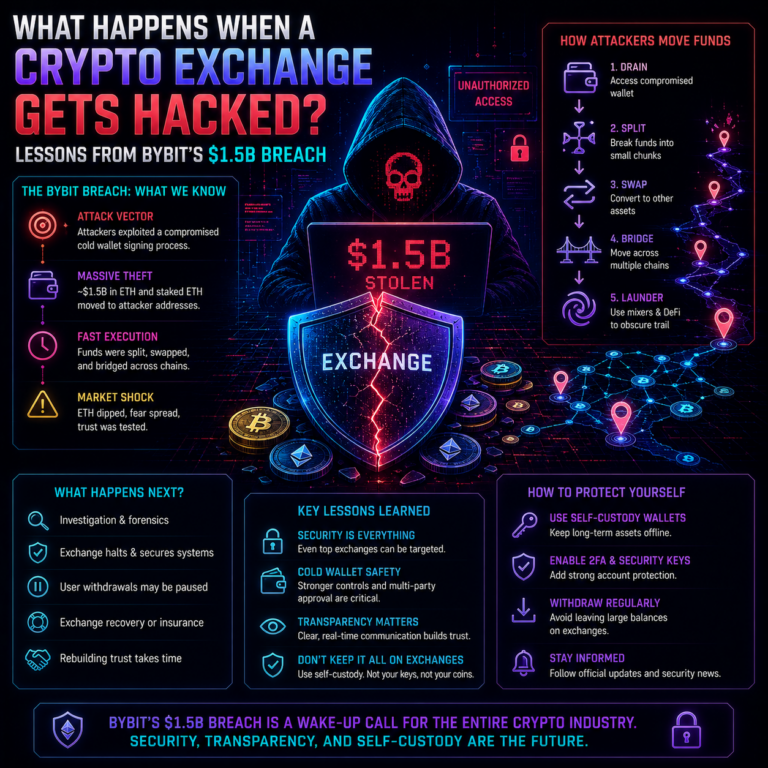
The custody row deserves particular attention. When you hold crypto on Coinbase or Binance, the exchange holds the private keys — not you. This convenience is, however, also a meaningful risk. When FTX collapsed in November 2022, billions in customer funds became inaccessible overnight. Customers who had moved their assets to self-custody wallets before the collapse lost nothing. Those who left funds on the exchange, by contrast, lost everything.
That’s not ancient history to be dismissed. It remains the clearest real-world illustration of why the centralization vs decentralization question has direct, practical consequences for whether you actually own what you think you own.
Why Decentralization Is the Foundation of Crypto
Bitcoin wasn’t created to be a speculative asset. Back in 2008, as governments bailed out banks after a financial crisis those same banks had helped cause, an anonymous developer named Satoshi Nakamoto published a whitepaper proposing a peer-to-peer electronic cash system that required no trusted third party — no bank, no government, no company that could fail, be corrupted, or be coerced.
That founding principle is therefore what decentralization means at its most fundamental level in crypto: financial transactions should be possible between any two people, anywhere in the world, without requiring any central authority’s permission.
In practice, decentralization delivers four things that centralized systems structurally cannot provide:
- True asset ownership. When you hold crypto in a self-custody wallet, you own it outright. No one can freeze it, seize it, or prevent you from moving it — as long as you control your own private keys.
- Permissionless access. Anyone with an internet connection can interact with Bitcoin or Ethereum. No bank account required, no credit check, no approval process. In countries where large portions of the population lack access to traditional banking, this matters enormously.
- Censorship resistance. Governments in multiple countries have attempted to restrict or ban Bitcoin. The network has continued operating regardless, because no single jurisdiction controls enough nodes to take it down.
- Transparent, tamper-proof records. Every Bitcoin transaction ever made is publicly visible and permanently recorded on-chain. No company can quietly adjust its books, and no government can alter the ledger.
The Real Limitations of Decentralization
Decentralization isn’t a pure upgrade over centralized systems, and anyone presenting it that way is overselling it. There are genuine, significant downsides that every crypto participant should understand before committing funds.
Smart contract risk is real and costly. In March 2026, Solana’s Drift Protocol — a decentralized exchange — was exploited for $285 million, representing over 50% of its total TVL. Similarly, the Wormhole bridge exploit in 2022 drained $320 million in wrapped assets. Unlike centralized platforms, decentralized protocols have no fraud department, no customer support, and no recourse mechanism. When a smart contract contains a bug and someone exploits it, those funds are gone permanently.
User error is permanent. Send crypto to the wrong address on a decentralized network and it’s unrecoverable. Likewise, lose your seed phrase and your wallet becomes inaccessible forever — there is no password reset, no support ticket, and no appeals process. The responsibility falls entirely on the user, which is empowering if you’re careful and catastrophic if you’re not.
Governance moves slowly. Upgrading a decentralized protocol requires broad community consensus. As a result, this process can lead to years of debate over relatively minor changes, network forks when the community can’t agree, and situations where known vulnerabilities linger because the governance process to fix them is simply too slow.
True decentralization is rarer than claimed. Many projects market themselves as decentralized but fall well short in practice. When three developers hold admin keys that can pause the entire protocol, that’s not decentralized — regardless of how it’s described. Similarly, when the founding team controls 60% of a governance token, community votes are largely performative. Always approach decentralization claims with healthy skepticism before committing funds.
Where Things Stand in 2026: The Hybrid Reality
The clean binary of “centralized vs decentralized” has been getting messier for years. In 2026, the more accurate picture is a spectrum — and most of the interesting activity is happening somewhere in the middle.
Centralized exchanges like Coinbase and Binance still dominate — CEXs hold roughly 87.4% of total crypto exchange market share, with DEXs accounting for the remaining 12.6%. Most people buying crypto for the first time use a centralized platform because the experience is simply easier. That said, this dominance is narrowing as DeFi infrastructure matures.
Meanwhile, DeFi is no longer a fringe activity by any measure. Hyperliquid, a decentralized perpetuals exchange, recorded approximately $208 billion in 30-day trading volume as of March 2026 — a figure that would have seemed impossible for a DEX just two years ago. Furthermore, Aave’s V4 upgrade launched in March 2026 introduced cross-market liquidity architecture that makes it a genuinely institutional-grade lending platform. BlackRock putting a $2.2 billion Treasury fund on Uniswap isn’t a symbolic gesture — it’s a practical infrastructure decision by the world’s largest asset manager.
Indeed, the term gaining traction across the industry is CeDeFi — centralized and decentralized finance working together. Centralized front-ends sit on top of decentralized settlement layers. Regulated custodians interface directly with permissionless protocols. The direction isn’t toward one model winning — it’s toward a spectrum where different combinations serve different needs, and sophisticated participants use both deliberately.
What This Means for Your Crypto Decisions Right Now
The centralization vs decentralization question isn’t just theoretical. In fact, it should directly shape where you store your assets and which platforms you trust with them.
When centralized is the right choice
- You’re new to crypto and still learning — a regulated exchange with customer support is a sensible and practical starting point
- You’re actively trading and need fast execution, fiat on-ramps, and straightforward account recovery options
- You’re holding smaller amounts where the convenience genuinely outweighs the custody risk
- You need to convert crypto back to fiat — most DeFi protocols don’t handle fiat currency at all
When decentralized makes more sense
- You’re holding significant amounts for the long term — self-custody eliminates exchange counterparty risk entirely
- You want to participate in DeFi: lending, borrowing, liquidity provision, or governance voting
- You’re in a country with unstable banking or currency controls — permissionless access becomes far more valuable in that context
- You’ve learned enough to manage your own private keys responsibly, with your seed phrase secured offline and a hardware wallet in use
Most experienced crypto participants, therefore, use both. A regulated exchange handles buying, selling, and fiat conversion. Meanwhile, self-custody wallets hold anything worth protecting seriously, and DeFi protocols handle yield generation and on-chain activity. The two approaches aren’t mutually exclusive — they serve genuinely different purposes within the same portfolio.
Frequently Asked Questions
Is Bitcoin fully decentralized?
More so than almost any other network, but not perfectly. Bitcoin mining has concentrated among large industrial operations over time, which raises theoretical concerns about hash power concentration. In practice, however, Bitcoin’s decentralization has proven remarkably robust — no single entity has successfully manipulated the network across 16+ years of continuous operation. As a result, it remains the gold standard for decentralization in crypto.
Are decentralized exchanges safe to use?
DEXs remove the risk of a centralized company misusing or losing your funds — but they introduce smart contract risk in its place. Exploits like the Drift Protocol hack ($285 million in March 2026) show that even established DEXs can be vulnerable. For that reason, stick to audited protocols with long track records — Uniswap, Aave, Curve — rather than newer or unaudited projects. Never put more into a DeFi protocol than you’d be genuinely willing to lose to a smart contract bug.
What is a seed phrase and why does it matter?
A seed phrase is a 12 or 24-word backup that provides complete access to a self-custody wallet. It represents the physical embodiment of decentralization — whoever holds the seed phrase controls the wallet, with no company or authority able to override that. Write it down on paper, store it securely offline, and never share it digitally under any circumstances. Lose it and the wallet becomes permanently inaccessible. Ultimately, this is the responsibility that comes with true ownership.
Can DeFi be regulated?
It’s an active and unresolved debate. Six major economies now have dedicated crypto rules in place — the US GENIUS Act, the EU’s MiCA framework, and separate licensing systems in Hong Kong, Singapore, Japan, and the UAE. However, comprehensive regulation covering DeFi protocols themselves — rather than just centralized crypto businesses — remains largely undrafted globally. The fundamental challenge is that you can’t serve a subpoena to a smart contract. Consequently, regulators are most likely to focus on the centralized interfaces — front-ends, stablecoin issuers, fiat on-ramps — rather than the underlying protocols.
What’s the practical difference between a CEX and a DEX?
A CEX (centralized exchange) is a company that holds your assets and facilitates trades — Coinbase, Binance, Kraken. It offers customer support, account recovery, and regulatory compliance, but maintains custody of your funds throughout. A DEX (decentralized exchange), by contrast, is a smart contract that automatically matches buyers and sellers using liquidity pools — Uniswap, Curve, Jupiter on Solana. You trade directly from your own wallet, so no company ever holds your funds. The trade-off is additional complexity and smart contract risk in exchange for self-custody and permissionless access.
The Bottom Line
Centralization and decentralization aren’t competing ideologies — they’re different tools with different trade-offs. On one hand, centralized systems deliver speed, recovery mechanisms, and a user-friendly experience that makes crypto accessible to newcomers. On the other, decentralized systems provide true ownership, censorship resistance, and access that requires no one’s permission.
The $130–140 billion locked in DeFi protocols demonstrates that decentralization works at meaningful scale. Nevertheless, the fact that centralized exchanges still handle 87% of crypto trading volume shows that centralization retains clear advantages for most people most of the time.
Where you sit on that spectrum should depend on what you’re actually trying to accomplish — and how much responsibility you’re ready to take on for your own assets. As a practical starting point, consider using a centralized exchange for buying and selling, while keeping a self-custody wallet for anything you’d be genuinely upset to lose. That combination captures most of the advantages of both models without forcing you to choose one absolutely over the other.
This article is for informational and educational purposes only. It does not constitute financial advice. Cryptocurrency and DeFi investments carry significant risk, including smart contract vulnerabilities and the potential loss of capital. Always conduct your own research before making any investment decision.
Data sources: DeFiLlama, CoinLaw, NFT Plazas, MetaMask News, KuCoin (April 2026)