Skip to main content







By: Senior Crypto Analyst Adam Taylor, CryptoLikeThis | Updated: April 28, 2026 | 7 min read
Ask anyone who’s been in crypto more than a week and they’ll tell you the same thing: the hardest part isn’t buying your first coin. It’s figuring out which coins are actually worth paying attention to — and which ones are just noise dressed up as opportunity.
Meme coins and utility coins sit at opposite ends of that question. One category is built on community belief and internet culture. The other is built on actual network infrastructure that people need to use blockchain at all. Both have made investors rich. Both have wiped people out. And in 2026, the line between them is blurrier than it’s ever been.
This guide cuts through it. Real numbers, real examples, and an honest take on where each type fits — and where it doesn’t.
What Are Meme Coins?
Dogecoin started as a joke. Literally — two software engineers, Billy Markus and Jackson Palmer, launched it in December 2013 based on a Shiba Inu dog meme that was doing the rounds on Reddit at the time. They expected it to disappear within months. By April 2026 it’s trading at around $0.090 with roughly $2 billion in daily trading volume. That’s more liquidity than most serious blockchain projects will ever see.
That history matters because it tells you something honest about what meme coins actually are: cryptocurrencies where the community is the product. There’s no whitepaper that explains why DOGE should be worth $22 billion. There’s no technology that couldn’t be replicated over a weekend. What there is is 12 years of cultural staying power and a community that has refused to let it die through multiple brutal bear markets.
That’s not nothing. It’s actually quite hard to replicate.
Top meme coins by market cap — April 2026
| Coin | Ticker | Approx. Market Cap | What makes it stick |
|---|---|---|---|
| Dogecoin | DOGE | ~$22B | The original. 12+ years of survival, deepest liquidity in the space |
| Shiba Inu | SHIB | ~$3.57B | Its own Layer 2 (Shibarium), 1.5M+ holders, SEC digital commodity status |
| Bonk | BONK | ~$1.71B | Solana’s native meme coin — 119+ integrations, embedded in the ecosystem |
| Pepe | PEPE | ~$1.40B | Pure meme, zero pretence at utility — trades on cultural resonance alone |
| Floki | FLOKI | ~$500M+ | Pushing into gaming and NFTs — one of the clearer meme-to-ecosystem pivots |
Sources: CoinGecko, CoinMarketCap, Coinspeaker (April 2026)
One thing worth noting in that table: four of those five coins aren’t really pure meme coins anymore. SHIB has a functioning Layer 2 network that’s processed over 1.5 billion transactions. BONK is woven into Solana DeFi across 10 blockchains. FLOKI has gaming infrastructure. The only one on that list that remains a straightforward bet on vibes is PEPE — and even that has a $1.4 billion market cap to show for it.
What actually moves meme coin prices? A few things, and they don’t always work in sequence. A Binance listing can double a coin overnight — it signals legitimacy and opens access to millions of buyers at once. A viral tweet from the right account can do similar damage in hours. Bitcoin bull markets tend to lift the whole meme sector disproportionately, because retail money flows in and new investors go looking for cheap tokens with recognisable names. And narrative cycles rotate constantly — AI meme coins dominated for a few months in 2025, PolitiFi tokens have had their moment in 2026. Whatever the current story is, meme coins find a way to attach themselves to it.
What Are Utility Coins?
Utility coins work differently at a fundamental level. You don’t buy ETH because you like Ethereum’s branding. You buy ETH — or you need ETH, more accurately — because every single transaction on the Ethereum network requires it. Want to swap tokens on Uniswap? You need ETH for gas. Minting an NFT? ETH. Interacting with any Ethereum DeFi protocol? ETH. The demand isn’t driven by community excitement. It’s driven by the fact that the network won’t function without it.
That’s the core difference. Utility coins have a reason to exist that doesn’t depend on anyone staying excited about them.
What utility coins are actually used for
- Gas fees — paying for transactions on-chain (ETH on Ethereum, SOL on Solana, BNB on BNB Chain)
- Staking — locking tokens to validate the network and earn yield in return
- Governance — voting on protocol upgrades and changes; some tokens give holders direct influence over how a network evolves
- dApp access — certain decentralised applications require their native token to unlock features
- Network security — validators put tokens up as collateral; if they behave dishonestly, they lose it
The main utility coins — April 2026
| Coin | Ticker | What it does | Why it matters |
|---|---|---|---|
| Ethereum | ETH | Gas fees, smart contracts, staking | The largest DeFi and NFT ecosystem in existence runs on it |
| BNB | BNB | Binance fee discounts, BNB Chain gas | One of the highest-volume exchange ecosystems globally |
| Solana | SOL | Fast transactions, staking | Now the dominant chain for meme trading and high-speed DeFi |
| Chainlink | LINK | Oracle data feeds | Connects blockchains to real-world data — used by most major DeFi protocols |
| Cardano | ADA | Staking, governance, smart contracts | Proof-of-stake chain with active governance and a large global community |
The price logic for utility coins is grounded in something measurable. More activity on Solana means more SOL needed for fees. Ethereum’s fee-burning mechanism means higher network usage leads to more ETH being destroyed, which is deflationary. These aren’t guarantees of price appreciation, but there’s an economic underpinning that meme coins simply don’t have.
The Key Differences, Side by Side
| Feature | Meme Coins | Utility Coins |
|---|---|---|
| Value driver | Community, virality, hype cycles | Network usage, real functional demand |
| Volatility | Extreme — can double or halve in days | High, but generally less violent than meme coins |
| Use case | Mostly speculative; top coins developing ecosystems | Transaction fees, staking, governance, dApp access |
| Who buys them | Retail traders, community participants, short-term speculators | Long-term holders, developers, institutional investors |
| Risk | Very high — most new launches fail within months | High, but established coins have multi-cycle survival records |
| What kills them | Attention moving elsewhere, whale exits, narrative rotation | Faster competing chains, reduced network activity, macro selloffs |
Why 2026 Makes This Harder to Answer Than It Used to Be
Five years ago this was a cleaner distinction. Meme coins were dog tokens people bought for laughs. Utility coins were the infrastructure layer serious builders worked on. That’s not quite how it works anymore.
Shiba Inu is the clearest example. It launched in 2020 as an anonymous Dogecoin clone — no team, no roadmap, no use case beyond being a cheaper DOGE. Today it has Shibarium, its own Layer 2 that’s processed more than 1.5 billion transactions. It’s been classified as a digital commodity by the SEC and CFTC. It’s on Japan’s JVCEA Green List alongside Bitcoin and Ethereum. Still technically a meme coin. Increasingly not behaving like one.
BONK is another one. It launched as a Christmas Day 2022 airdrop on Solana — a community gag, essentially. By 2026 it has integrations across 10 different blockchains, powers BonkSwap and BonkBot, and is embedded in Solana’s DeFi ecosystem. 660,000 holders. $1.7 billion market cap. That’s not a joke coin anymore, even if the mascot is still a cartoon dog.
The better question to ask — more useful than “is this a meme coin or a utility coin?” — is whether a project has genuine adoption or whether it’s running on hype alone. The category label matters less than the answer to that question.
The Risk Picture — Both Sides
Nobody should be buying either category without understanding what can go wrong. And plenty can.
On the meme coin side: the sector’s total market cap fell 61% in 2025 as the market turned risk-off. Coins that hit $1-2 billion valuations in January 2025 were sitting at $30-50 million by year end. Goatseus Maximus (GOAT) — the first “AI meme coin” — peaked at $1.5 billion before collapsing to around $33 million. According to data from 99Bitcoins, over 86% of total meme coin market cap is concentrated in independently-launched coins with real communities behind them, which means the vast majority of new launches have minimal chance of survival. Most will be forgotten within a year of launch.
On the utility coin side, the risk is different but real. Ethereum held near-total DeFi dominance for years. Solana ate significant market share by being faster and cheaper. Now Monad launched in late 2025 with 10,000+ transactions per second and is building its own meme and DeFi ecosystem. Being a utility coin doesn’t protect you from being made obsolete. Network competition in crypto is brutal and ongoing.
Which One Actually Makes Sense for You?
There’s no single right answer, and anyone who tells you otherwise is selling something. It really does depend on what you’re trying to do.
Meme coins might make sense if:
- You’re comfortable with the fact that you could lose most of what you put in — and you’re not putting in money that would hurt to lose
- You’re actively engaged with crypto communities and can read sentiment shifts early
- You’re interested in short-term trades rather than building a long-term position
- You’re sticking to coins with genuine track records — DOGE and SHIB have survived conditions that killed thousands of their contemporaries
Utility coins might make sense if:
- You want to build a crypto portfolio that’s tied to something more measurable than community excitement
- Your time horizon is years rather than weeks
- You want to earn staking yield rather than just sitting on spot exposure
- You’re new to crypto and still learning — utility coins give you something concrete to research and understand
Most people who’ve been in this space for a while hold both. Utility coins as the foundation, a small slice of meme coin exposure for asymmetric upside. Small being the operative word — there’s a meaningful difference between 5-10% of a portfolio in meme coins and going half-in on the newest Solana dog token because someone on X told you it was going to 100x.
What’s Changed in 2026
A few things are worth flagging if you’re coming at this fresh.
Solana now dominates meme coin trading. Pump.fun has become the de facto launchpad — cheap fees and fast transactions make it the natural home for new token launches. If you’re looking at anything that launched in the past 12 months, there’s a good chance it’s on Solana.
AI meme coins had their moment in 2025 and mostly imploded. GOAT being the cautionary example everyone references now. That doesn’t mean the AI-crypto narrative is dead — it just means attaching “AI” to a meme token isn’t the automatic growth driver it briefly was.
PolitiFi tokens — politically-themed meme coins — have become a genuine sub-category following the Trump token launch ahead of the 2025 inauguration. They carry extra volatility on top of the usual meme coin risk because they’re subject to news cycles, regulatory attention, and the general chaos of politics.
And the blurring between categories is only going to continue. CoinGecko notes that successful meme coins are increasingly spinning out into Layer 2 networks, DEXs, and game ecosystems. The ones that don’t evolve tend to fade. Worth keeping in mind when you’re evaluating anything in this space.
Frequently Asked Questions
Can meme coins have real value if they have no utility?
Yes — Dogecoin is a $22 billion proof of that. Community loyalty and cultural staying power are genuine forms of value, even without a use case. The catch is that community attention is fickle and can disappear faster than it arrived. Utility-driven demand tends to be more durable because people need the coin to actually use the network.
Are utility coins safer than meme coins?
Broadly yes, but with caveats. ETH and SOL have survived multiple full market cycles and have real developer ecosystems behind them. Smaller utility tokens without proven adoption carry their own failure risk — the “utility” label isn’t a safety guarantee. For lower risk, stick to the established names with long track records.
How do I tell the difference between a meme coin and a scam?
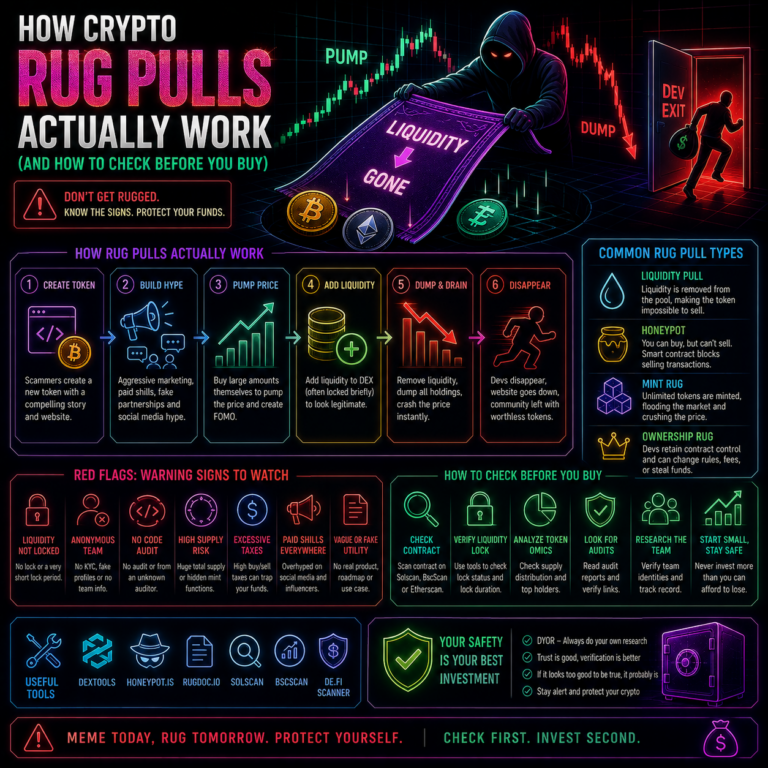
Legitimate meme coins — even pure speculation plays like PEPE — trade on major exchanges, have verifiable on-chain data, and have auditable transaction histories. Rug pulls are designed to drain capital, usually through anonymous teams abandoning the project and pulling liquidity. Red flags: no exchange listings, no liquidity lock, anonymous team with no history, and anyone aggressively pushing you to buy before you “miss the window.”
Is Dogecoin still a meme coin?
By origin, absolutely. But calling it just a meme coin undersells what it’s become. It’s listed on every major exchange, integrated into X Payments for tipping and transactions, and has been described by analysts as the blue-chip of the meme world. It carries different risk to a six-month-old Solana token — the category label is the same but the reality isn’t.
Should a beginner start with meme coins or utility coins?
Utility coins first. Get a foundation in ETH, SOL, or BNB before touching anything meme-related. You’ll understand blockchain better, you’ll have something concrete to research, and you won’t be starting with the most volatile assets in the space. Add meme coin exposure once you understand what you’re doing — and if you do, stick to DOGE or SHIB rather than whatever launched last week.
The Bottom Line
Meme coins and utility coins answer the same question differently: what makes a cryptocurrency worth holding?
Utility coins say the network does. If people use it, it has value — and that value compounds as adoption grows. Meme coins say the community does. If enough people believe in it and keep believing, the price reflects that belief. Both answers have worked. Both have also failed spectacularly.
The $37.6 billion meme coin market in April 2026 isn’t something you can dismiss. But the 61% wipeout from the 2025 peak isn’t something you can ignore either. The honest framing is this: meme coins are high-risk, high-potential, community-dependent bets. Utility coins are high-risk, lower-volatility, adoption-dependent bets. Neither is a sure thing. Both can have a place in a portfolio if you understand what you’re actually holding — and why.
This article is for informational and educational purposes only and does not constitute financial advice. Cryptocurrency investments carry significant risk. Always do your own research before making any investment decision.
Data sources: CoinGecko, CoinMarketCap, Coinspeaker, 99Bitcoins, CoinMarketCap Academy (April 2026)