Skip to main content







The version of this page we are replacing argued that a bull cycle was forming quietly while few were paying attention. Crypto market sentiment 2026 data makes that easy to check, and the answer is the reverse of what the draft assumed. Attention has already returned. Sentiment indices have climbed out of the deepest fear on record into neutral and greedy territory. What has not returned is the money, and that gap is the genuinely interesting thing about this market.
Key Takeaways
- Bitcoin fell 45.6% during the past year, from $119,222 to a low of $58,621.70 on 30 June 2026.
- It traded around $77,157 on 3 September 2026, roughly 31.6% above that June floor.
- Crypto market sentiment 2026 readings range from 44 to 69 across providers, a 25-point spread on the same day.
- Binance’s monthly volume fell about 45% year on year and OKX’s about 58%.
- Since February 2018 the market has sat in Fear or Extreme Fear roughly 62% of the time, so fear is the default state, not a signal.
How bad crypto market sentiment 2026 actually got
The draft described sentiment as cautious. The record from earlier in 2026 was considerably worse than that, and the detail matters because it sets the baseline for any recovery claim.
According to CFGI’s records, the market sentiment index closed at 12 on 5 February 2026, the most fearful daily reading since its tracking began in March 2022. Bitcoin’s own reading hit 10 out of 100 that day, with the price at $63,548.50 and 98 of the 102 assets then scored closing in Fear or worse. A three-day Extreme Fear streak followed from 4 to 6 June, logging 15 and then 16.
The price told the same story. Bitcoin fell 45.6% over the year from $119,222 to $64,819, touching $58,621.70 on 30 June 2026. At $77,157 on 3 September it sits about 31.6% above that low.
Where sentiment actually sits now
Here is the first surprise. Readings today depend heavily on who you ask.
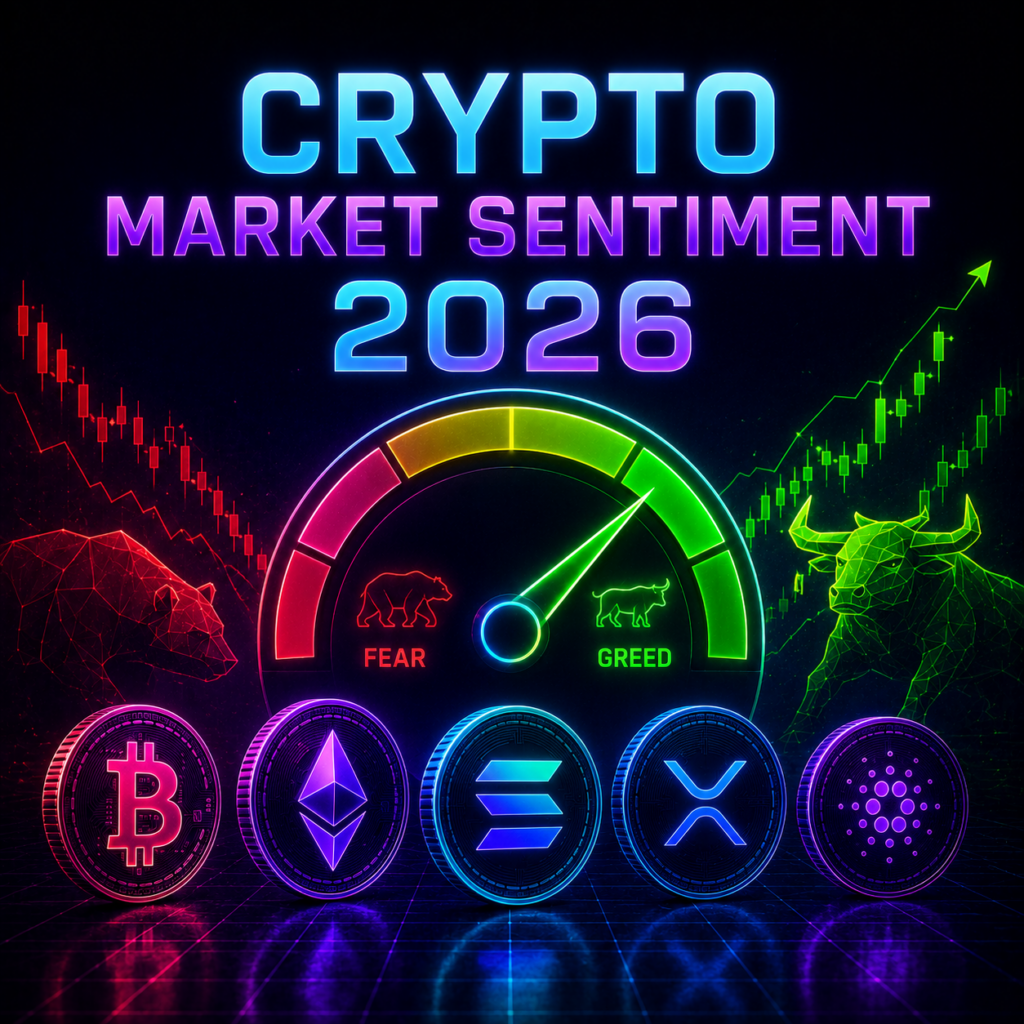
CoinGecko’s index showed 69, in Greed, against 27 a month earlier. CFGI’s market composite reads in the 44 to 50 range, described as Neutral, with its Bitcoin-specific index at 58. That is a 25-point spread on a 0 to 100 scale, measured on the same day, because each provider weights different inputs.
What they agree on is direction. Every reading is far above February’s 12 and June’s 15. Crypto market sentiment 2026 has recovered substantially from the floor, which means the premise that few are paying attention no longer holds. People are paying attention. Some measures say they are already greedy.
The part that has not recovered
Now the finding makes this worth reading. Sentiment came back. Trading did not.
A CryptoQuant analyst noted Binance processed roughly $2.55 trillion in volume during July 2025 against approximately $1.4 trillion in July 2026, a fall of about 45%. OKX declined from roughly $1.055 trillion to $447 billion, close to 58%. Those are enormous contractions in turnover at the two largest venues by volume.
So the market has enthusiasm without participation. That combination is unusual and it undermines one of the old draft’s specific claims directly, which was that liquidity is gradually returning and trading volumes are increasing. Measured year on year at the largest exchanges, the opposite happened. Our coverage of crypto volatility and ETF inflows looks at where the flow that does exist is going.
Why “sentiment is fearful” is a weak signal anyway
This is worth knowing before reading any crypto market sentiment 2026 analysis, including this one.
Analysis published by Milk Road notes that since February 2018 the market has been in a state of Extreme Fear or Fear roughly 62% of the time, 1,172 days out of 1,900. Fear is not an anomaly that marks a bottom. It is the market’s resting state, and an index sitting in fear tells you very little on its own.
The same analysis notes the index moves an average of about 4 points per day against Bitcoin’s average daily price move of 2.5%, meaning sentiment is more volatile than the thing it measures. Treating a single daily reading as a signal is reading noise.
What the old draft got right
Two of its structural observations hold up, and it would be unfair to dismiss the whole thing.
Higher lows are real. Bitcoin’s June floor at $58,621.70 and its current level near $77,157 is a meaningful recovery off the bottom, and the pattern repeats across other large assets. That is genuine structural improvement.
And the observation that early cycle phases feel unconvincing is accurate as a description of how markets behave. Where the draft went wrong was assuming that because the phase feels uncertain, it must be early. Uncertainty is compatible with a bottom and equally compatible with a pause. Our piece on whether Bitcoin is undervalued in 2026 covers the valuation question underneath that.
What would actually confirm a turn
Three things would confirm a turn, and they follow from what is missing rather than what is present.
Exchange turnover recovering. Sentiment without volume is a crowd watching rather than participating, and volume is the harder of the two to fake.
Sentiment holding in neutral or better across multiple providers rather than one. Given a 25-point spread between indices on the same day, agreement between them is more informative than any single number.
Bitcoin holding above its June low on a genuine retest. It has not been tested since, so the higher low remains unconfirmed in the way that matters.
Final Thoughts
The honest reading of crypto market sentiment 2026 is that the fear has gone and the money has not come back. Indices have climbed from a record low of 12 in February to somewhere between 44 and 69 depending on the provider. Turnover at the two largest exchanges has roughly halved year on year.
That is a market where the mood recovered faster than the participation, which is not the setup the original article described. Watch volume rather than sentiment, treat any single index reading as one opinion among several, and remember that fear has been the market’s normal condition for 62% of the last eight years.
Disclaimer: This article is for informational and educational purposes only and is not financial or investment advice. Sentiment indices measure mood, not value, and different providers produce materially different readings for the same day. Nothing here is a forecast. Crypto prices are volatile and you may lose money. Every figure carries its source and date. Do your own research and consider speaking to a qualified professional. See our editorial policy for how we source and verify our reporting.
Data Sources
- CFGI, Crypto Fear and Greed Index and Bitcoin Fear and Greed Index, checked September 2026
- Milk Road, Fear and Greed Index analysis and historical distribution
- CryptoRank, exchange volume data attributed to CryptoQuant, August 2026
- CoinGecko, Bitcoin price and market data, checked 3 September 2026