How we build a price outlook: This analysis combines technical and fundamental inputs. Technical: historical price behaviour, support and resistance, the 52 week range, volume and momentum. Fundamental: token supply dynamics and emissions, network activity, ecosystem developments, and market sentiment. Outputs are conditional scenarios with the assumptions stated, not a single number. Third party figures are named and dated.
Disclaimer: This article is for informational and educational purposes only and is not financial or investment advice. Cryptocurrency prices are volatile and you may lose money. No scenario here is a forecast of what will happen, and no outcome is assured. Do your own research and consider speaking to a qualified professional before making investment decisions. See our editorial policy for how we source and verify our reporting.
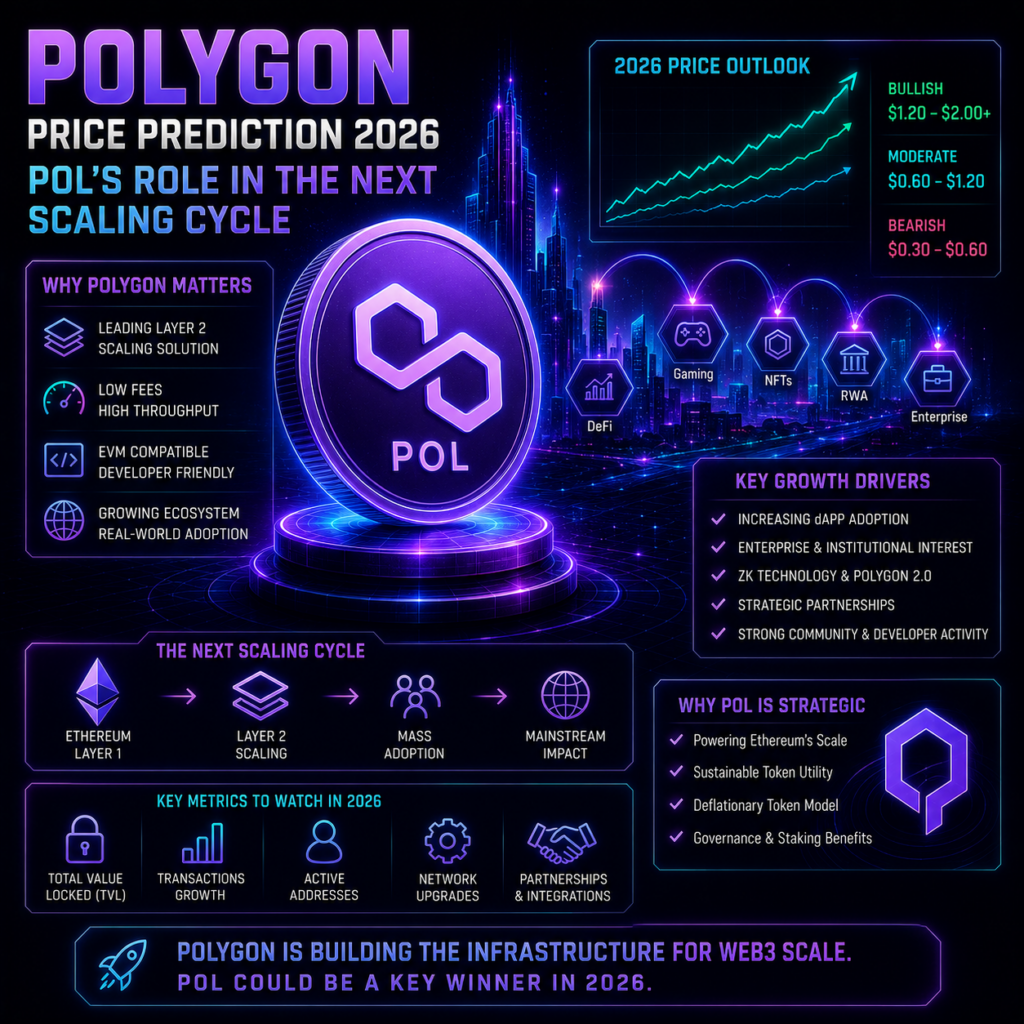
Before any Polygon price prediction 2026 makes sense, one point needs clearing up, because it still confuses people two years on. MATIC and POL are the same asset. The ticker changed, the holdings did not. Anyone searching for a MATIC forecast is searching for a token that no longer exists under that name. This piece explains the migration properly, then works through where POL actually stands: near the bottom of its range, with a supply schedule that has no ceiling.
Key Takeaways
- POL traded near $0.1072 on 27 August 2026 per CoinGecko, market cap around $1.15 billion at rank 68.
- MATIC was upgraded to POL 1:1 from 4 September 2024, and Polygon reported the migration 99% complete a year later.
- POL’s all time low of $0.06771 was set on 1 July 2026, less than two months before this was written.
- CoinGecko lists POL’s maximum supply as uncapped, which is the most underdiscussed fact about the token.
- Network fees ran near $77,500 over 24 hours, small against a $1.15 billion valuation, which frames any Polygon price prediction 2026.
The MATIC to POL migration, explained properly
Polygon replaced MATIC with POL as the native gas and staking token of Polygon PoS. According to Polygon’s own developer documentation, the migration operates on a 1:1 basis: for every MATIC you migrate, you receive one POL.
What you had to do depended on where your tokens sat. MATIC on Polygon PoS converted automatically, with no action needed beyond possibly updating the token symbol in your wallet. MATIC on Ethereum needs manual migration through the Polygon Portal, still open today. Stakers and delegators needed to do nothing.
Polygon reported in September 2025 that 99% of MATIC had migrated, and that every Polygon PoS transaction had used POL as gas since September 2024. So the migration is effectively complete rather than formally closed, and the Portal handles the remainder.
Where POL stands today
CoinGecko put POL at about $0.1072 on 27 August 2026, down 10.4% on the day but up 29.2% over seven days and 44.7% over thirty. Market cap sat near $1.15 billion at rank 68, on circulating supply of 10.7 billion.
Two numbers matter more than the rally. The all time high of $1.29, set 13 March 2024, is roughly twelve times the current price. And the all time low of $0.06771 was set on 1 July 2026, so the recent move is a bounce off multi year lows, not a breakout from a base.
The supply picture deserves more attention than it gets in any Polygon price prediction 2026. CoinGecko lists POL’s maximum supply as uncapped, reflecting the emission schedule introduced with the new tokenomics. A token with no ceiling needs demand to grow simply to hold its price, a materially different proposition from a fixed-supply asset and one rarely mentioned in POL coverage.
What the network is actually earning
CoinGecko’s financial data, sourced from Token Terminal, showed POL recording roughly $77,500 in fees and $46,000 in project revenue over 24 hours. Annualise the fee figure crudely and you get something in the region of $28 million against a $1.15 billion market cap.
That is not a criticism of the technology. Polygon ships consistently, and its work on aggregation and cross-chain settlement is real, as our coverage of cross-chain interoperability discusses. The narrower point: the scaling narrative that carried MATIC in 2021 now competes with several credible alternatives, and our Ethereum versus Solana comparison covers where that sits.
Polygon price prediction 2026: the scenario framework
Bearish case. The bounce fades and POL retests the $0.068 area from July. Conditions: broad altcoin weakness, continued emission pressure without matching demand, or the recent 44% monthly move proving to be short covering.
Base case. POL ranges roughly between $0.08 and $0.13 into year-end, matching the seven-day range it has already traded. Adoption continues, fees stay modest, and the token moves with the wider market rather than ahead of it. This is where the evidence points.
Bullish case. A sustained hold above $0.13 would be the first higher high of consequence since the drawdown, opening the high teens in cents. Anything approaching the old $1.29 requires a twelvefold move, which needs a genuine re-rating of the scaling sector rather than incremental improvement.
What would change this view
Three indicators would move this Polygon price prediction 2026. Whether network fees grow into the valuation, the cleanest measure of usage converting to value. Whether POL holds above its July low on a retest, which would build the base that has not formed. And the net effect of emissions, since uncapped supply is a permanent headwind unless demand outpaces it.
Final Thoughts
The honest version of a Polygon price prediction 2026 is that POL is a recovering asset rather than a re-rating one. The migration was executed cleanly, the network works, and the price still made an all-time low eight weeks ago. Those facts sit together uncomfortably, and pretending otherwise would not help anyone.
Treat $0.08 to $0.13 as the working range, watch whether fees grow into the market cap, and remember the ticker changed while the underlying position did not. Re-check price and supply before acting, because both move and the second only moves one way.
Data Sources
- Polygon, Migrate to POL developer documentation, checked 27 August 2026
- Polygon, MATIC to POL Migration Is 99% Complete, September 2025
- Polygon, Polygon Portal migration interface, checked 27 August 2026
- CoinGecko, POL (ex-MATIC) price, supply and financial data, checked 27 August 2026