Skip to main content







READ THIS FIRST. THIS IS NOT TAX ADVICE.
This is general educational information about crypto taxes 2026 for US federal income tax purposes only. It is not tax, legal or financial advice and is no substitute for a professional who knows your circumstances. Outcomes depend on facts this article cannot know: your income, residency, state, how you hold assets and what you did with them. Rules differ by jurisdiction, state rules differ from federal rules, and guidance changes. Getting this wrong carries real legal and financial consequences, including penalties and interest.
Before you file or act on anything below, speak to a licensed tax professional. Every statement here is sourced to published IRS guidance, linked inline, and you should read the original. See our editorial policy for how we source and verify our reporting.
Most people who get into trouble with crypto taxes 2026 do not do it deliberately. They assume nothing happens until they cash out to a bank account. That assumption is wrong, and the reason is one line of IRS guidance: for US tax purposes, digital assets are property, not currency. Everything else follows. Here is what the IRS itself says, in plain language, with a source for each point.
Key Takeaways
- Crypto taxes 2026 rest on one rule: the IRS treats digital assets as property, so property rules apply to every disposal.
- Buying with dollars and holding is not a taxable event. Neither is moving crypto between wallets you own.
- Selling, swapping one token for another, and spending crypto on goods or services are all disposals.
- You must report taxable transactions whether or not you receive a tax form.
- Brokers began issuing Form 1099-DA in 2026 for 2025 activity, changing what the IRS can see.
Crypto taxes 2026 start with one definition
The IRS digital assets page, last reviewed 24 August 2026, states it directly: for US tax purposes, digital assets are property, not currency. The definition covers cryptocurrencies such as Bitcoin, stablecoins and NFTs.
Its FAQs on digital asset transactions repeat it at question 48: digital assets are treated as property, and the general tax principles applying to all property transactions apply to them. If you understand how selling a share of stock works, you understand the shape of crypto taxes 2026. Cost basis, disposal, and the difference is a gain or loss.
What is not a taxable event
This is where a lot of unnecessary anxiety about crypto taxes 2026 lives. Per the IRS digital assets page, you answer “No” to the digital assets question on your return if you only did the following:
- Held digital assets in a wallet or account without transacting
- Bought digital assets with US dollars or another real currency and did not sell them
- Transferred digital assets between wallets or accounts you own or control
That third point has one exception the IRS is explicit about. FAQ 81 confirms moving assets between your own wallets is non-taxable, except to the extent you use or have withheld digital assets to pay for the transfer. FAQ 97 explains why: paying a network fee in crypto is itself a disposal, so you recognise gain or loss on the fee. Our MetaMask guide covers the mechanics of those transfers.
One more that surprises people: FAQ 75 says receiving digital assets as a bona fide gift is not income when you receive it. You recognise nothing until you dispose of it.
What is a taxable event
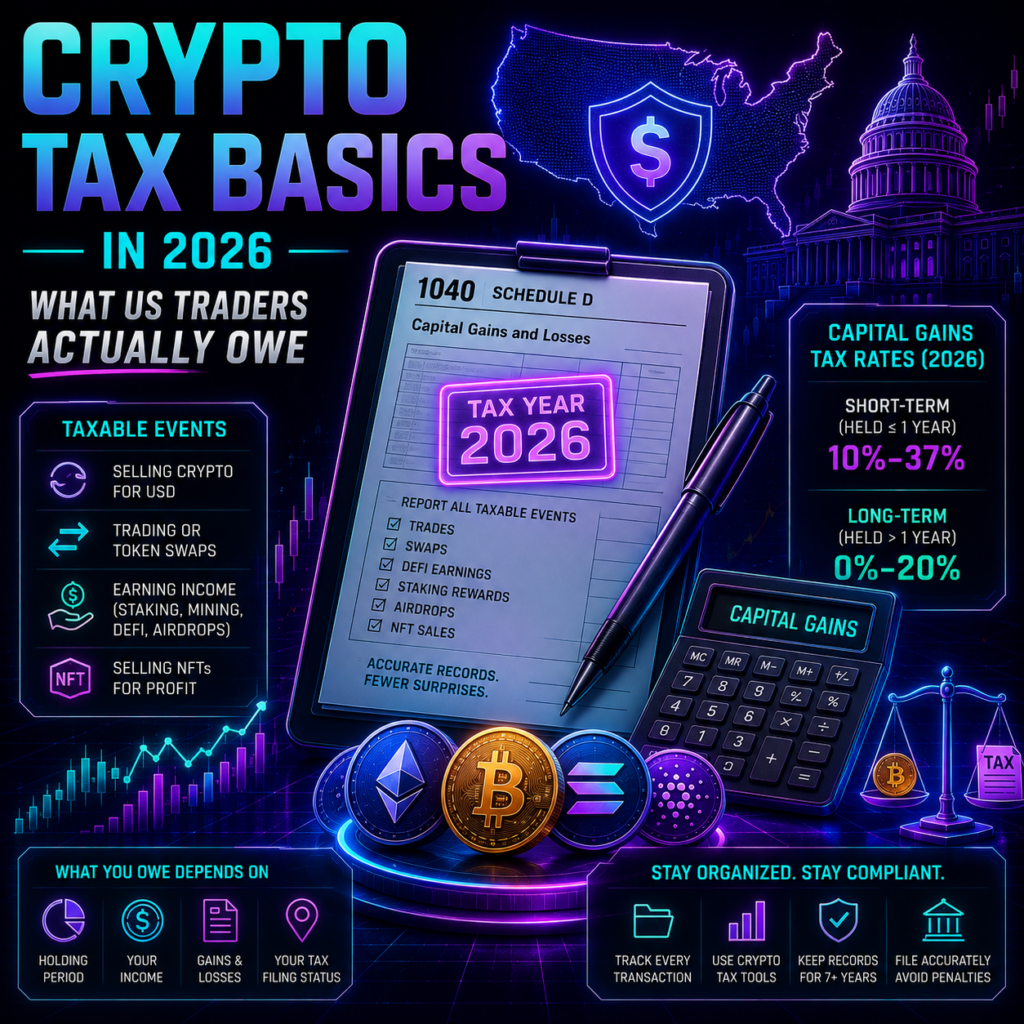
The IRS lists these as disposals. Each one triggers a gain or loss calculation, and together they are most of what crypto taxes 2026 actually covers.
- Selling for dollars. FAQ 49: if you sell digital assets for US dollars or similar currency, you must recognise any capital gain or loss.
- Swapping one token for another. FAQ 64: exchanging digital assets for other property, including other digital assets, produces a capital gain or loss. Trading Bitcoin for Ether is a disposal of the Bitcoin, even though no dollars moved.
- Spending it. FAQ 62: paying for services with digital assets means you disposed of them and have capital gain or loss. The digital assets page extends this to goods and property “in any amount”, so the guidance has no small-purchase carve-out.
- Getting paid in it. FAQ 57 and 58: receiving digital assets for services is ordinary income, measured at the fair market value in US dollars when received.
- Hard fork proceeds. FAQ 105 and 106: if you receive new digital assets after a hard fork and have dominion and control over them, that is ordinary income at fair market value when received.
And the rule that catches people out most often, FAQ 108: you must report income, gain or loss from all taxable transactions on your return for that year, regardless of the amount and regardless of whether you received a payee statement or information return. No form does not mean no obligation.
How long you held it changes the answer
FAQ 50 sets out the split. Hold for one year or less before selling or exchanging and you have a short-term capital gain or loss. Hold for more than one year and it is long-term. The holding period begins the day after you acquire the asset and ends the day you sell. The two are taxed differently, which is why acquisition dates matter as much as prices in crypto taxes 2026.
What changed for crypto taxes 2026
Visibility. Under the final broker reporting regulations, summarised on the IRS fact sheet, brokers must report gross proceeds for transactions effected on or after 1 January 2025, and basis on certain transactions effected on or after 1 January 2026. Form 1099-DA statements for 2025 activity reached taxpayers in early 2026.
Two practical consequences. Most 2025 statements report proceeds without basis, so proving what you paid still sits with you. And the regulations do not cover non-custodial or decentralised brokers, so plenty of activity generates no form at all. FAQ 108 still applies to all of it.
Records, and one scam to know about
FAQ 95 states the recordkeeping requirement plainly: you must maintain records sufficient to establish the positions taken on your return, including receipts, sales, exchanges, dispositions and transfers, and fair market value. In practice: date and time, number of units, US dollar value at the time, and what you paid.
Worth knowing while you think about crypto taxes 2026: on 30 July 2026 the IRS published a fraud alert about fake IRS letters sent to crypto holders. They carry a QR code and tell recipients to register for a “Digital Asset Compliance Portal” before a deadline. IRS Criminal Investigation Chief Jarod Koopman warned that criminals exploit public trust with convincing fake correspondence. The IRS does not operate such a portal and did not send those letters. If one arrives, do not scan the code.
Disclaimer: This article is for informational and educational purposes only and is not tax, legal, investment or financial advice. It covers US federal principles at a general level and does not address state taxes, non-US jurisdictions, or your individual circumstances. Rules vary by situation and change over time. Consult a licensed tax professional before filing or making decisions. See our editorial policy.
Final Thoughts
The fundamentals of crypto taxes 2026 are narrower than the internet makes them feel. Property rules apply. Buying and holding does nothing. Moving between your own wallets does nothing, except for the fee. Selling, swapping, spending and getting paid all count, and you report them whether or not a form arrives.
That leaves a recordkeeping problem more than a knowledge problem, and it gets harder the longer you leave it. If you are starting out, our guide to buying crypto is a sensible place to begin, and keeping records from day one beats reconstructing them in April. Then take the filing itself to someone licensed to advise you.
Data Sources
- Internal Revenue Service, Digital assets, page last reviewed 24 August 2026
- Internal Revenue Service, Frequently asked questions on digital asset transactions (FAQs 47 to 111, added 15 December 2025), page last reviewed 29 June 2026
- Internal Revenue Service, Final regulations and related IRS guidance for reporting by brokers on sales and exchanges of digital assets
- IRS Criminal Investigation, Fraud alert: Fake IRS letters target cryptocurrency holders, 30 July 2026