Market cap is the number every price page leads with, and on its own it can be badly misleading. It measures only the tokens circulating today. If most of a project’s supply is still locked, that figure describes a fraction of what the market will eventually have to absorb. Understanding market cap vs fully diluted valuation crypto pricing is one of the few evaluation habits that takes five minutes to learn and changes what you see on every token page afterwards. Here is the distinction, with real numbers from a live example.
Key Takeaways
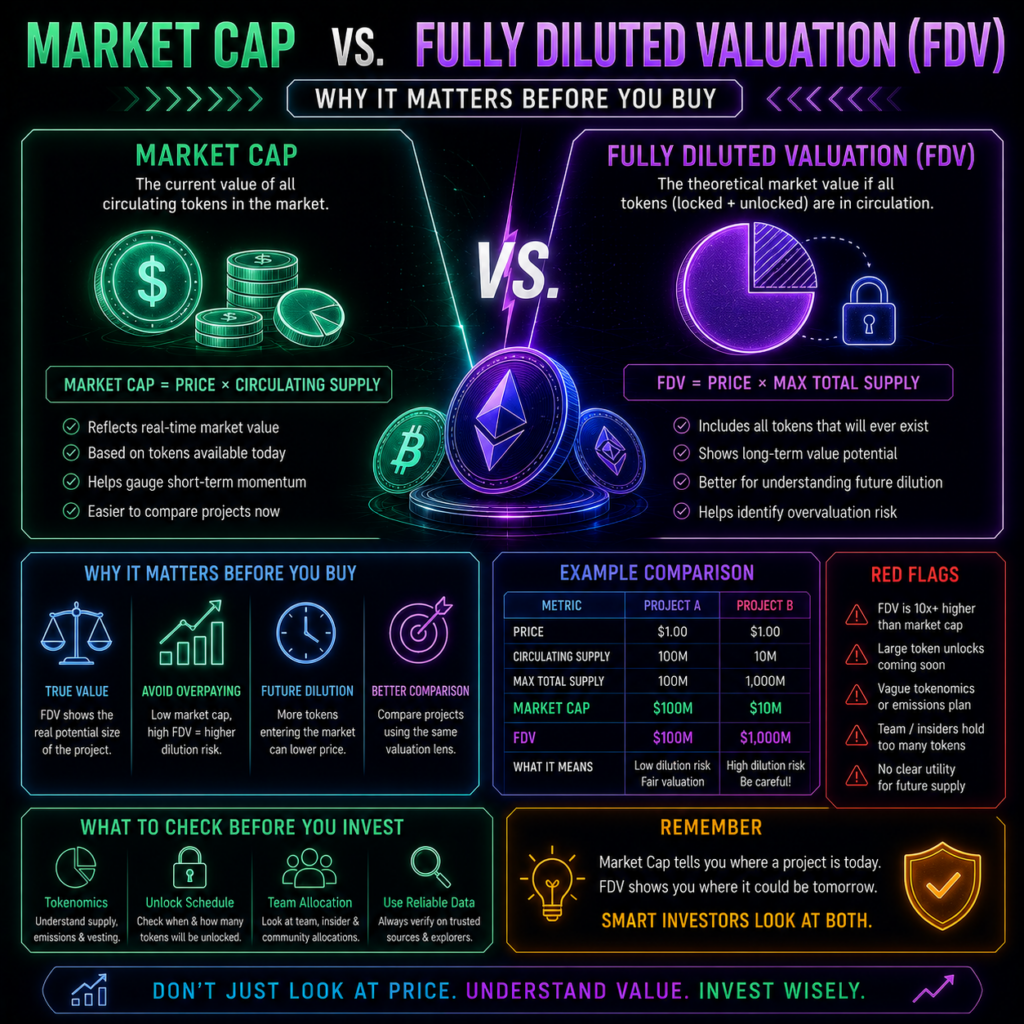
- The market cap vs fully diluted valuation crypto split is simple: market cap is price times circulating supply, FDV is price times total supply.
- CoinGecko’s Market Cap to FDV ratio makes the gap visible instantly. The closer to 1, the less dilution is pending.
- Worldcoin showed a market cap near $1.54 billion against an FDV of $4.25 billion on 28 August 2026, a ratio of 0.36.
- CoinGecko also publishes Outstanding Token Value, a third figure that excludes supply not planned for circulation.
- A low ratio is not automatically bad. It tells you to check the unlock schedule, not to avoid the token.
Market cap vs fully diluted valuation crypto: the definitions
Market capitalisation is the current price multiplied by circulating supply, where circulating means tokens available and tradable by the public. CoinGecko’s methodology compares it to shares readily available in a stock market, excluding those held and locked by insiders.
Fully diluted valuation is the current price multiplied by total supply, which is every token that will exist. CoinGecko’s explainer is careful to note that FDV is theoretical, because increasing circulating supply may itself affect price, and that emission schedules can mean years pass before the full supply arrives.
The useful shortcut is the ratio between them. A token with a Market Cap to FDV ratio near 1 has most of its supply already circulating. A ratio well below 1 means significant supply is still to come.
A live example, with real figures
Worldcoin makes the point cleanly because the numbers are large and public. On 28 August 2026, CoinGecko showed WLD at $0.4256, with a market cap of roughly $1.54 billion and a fully diluted valuation of $4.25 billion. Circulating supply was 3.617 billion against a total and maximum supply of 10 billion. Market Cap to FDV: 0.36.
Read what that means in plain terms. About 36% of the eventual supply is trading. At the current price, the tokens not yet circulating are worth roughly $2.7 billion, and at some point they arrive. For the price to hold as they do, demand has to grow enough to absorb them.
This is not a hypothetical mechanism. CoinGecko’s own news panel for the token on 28 August 2026 flagged a 2.2% drop attributed to a token unlock and low float concerns, alongside separate coverage of tokenomics and unlocks drawing market attention. The token also sits about 96.4% below its March 2024 all-time high.
None of that makes the project good or bad, and this is an illustration rather than a view on it. The point is narrower: anyone who looked only at the market cap saw a $1.54 billion asset. The market has $4.25 billion of eventual claims priced into the same token.
The third number almost nobody quotes
CoinGecko publishes a metric between the two called Outstanding Token Value, and it is the most practical of the three. It uses outstanding supply rather than maximum supply, excluding tokens that are permanently locked, burned, or not planned for release, such as treasury reserves or foundation allocations that will never circulate.
For Worldcoin on the same day, outstanding supply was 6.553 billion against a total of 10 billion, giving an Outstanding Token Value of $2.789 billion. That sits between the $1.54 billion market cap and the $4.25 billion FDV, and it is arguably the fairest of the three, because FDV assumes tokens reach the market that in some cases never will.
How to actually use this
Three habits turn the market cap vs fully diluted valuation crypto comparison into something useful. First, read the ratio before the price. A token at 0.1 is telling you 90% of supply is still to arrive, which is a different investment from one at 0.9. Second, find the unlock schedule, because timing matters as much as quantity: a slow release over ten years is not the same pressure as a cliff next quarter. Third, ask who receives the unlocked tokens, since early investors at a low cost basis behave differently from an ecosystem fund.
A low ratio is not a red flag by itself. Most young projects have one. It is a prompt to look at the supply schedule rather than a reason to walk away, and our guides on evaluating token sales and on meme coins versus utility coins cover the wider checks.
Disclaimer: This article is for informational and educational purposes only and is not financial or investment advice, and no token is endorsed or criticised. Worldcoin appears as a data illustration because its figures are public and clear, not as a recommendation either way. Crypto prices are volatile and you may lose money. Supply figures change as tokens unlock, so verify current data before relying on any of it. See our editorial policy for how we source and verify our reporting.
Final Thoughts
The market cap vs fully diluted valuation crypto distinction matters because the headline number is the one designed to look flattering. A project can present a modest market cap while carrying a valuation several times larger in tokens that have not arrived yet, and nothing about that is hidden. It is published on the same page, one line down.
Check the ratio, then the unlock schedule, then who is receiving the tokens. It takes a couple of minutes and it is the difference between knowing what something costs and knowing what you are actually buying.
Data Sources
- CoinGecko, Worldcoin (WLD) price, supply and valuation data, read 28 August 2026
- CoinGecko, What is Fully Diluted Valuation (FDV) in crypto
- CoinGecko, Methodology, including how market cap and supply are defined