







AI DeFi 2026: Autonomous Agents Now Manage the Majority of On-Chain Portfolios

AI DeFi in 2026 offers automated portfolio management. Discover how autonomous agents identify yield opportunities and secure decentralized investments.
DePIN Explained: The Infrastructure Networks Powering Web3 in 2026
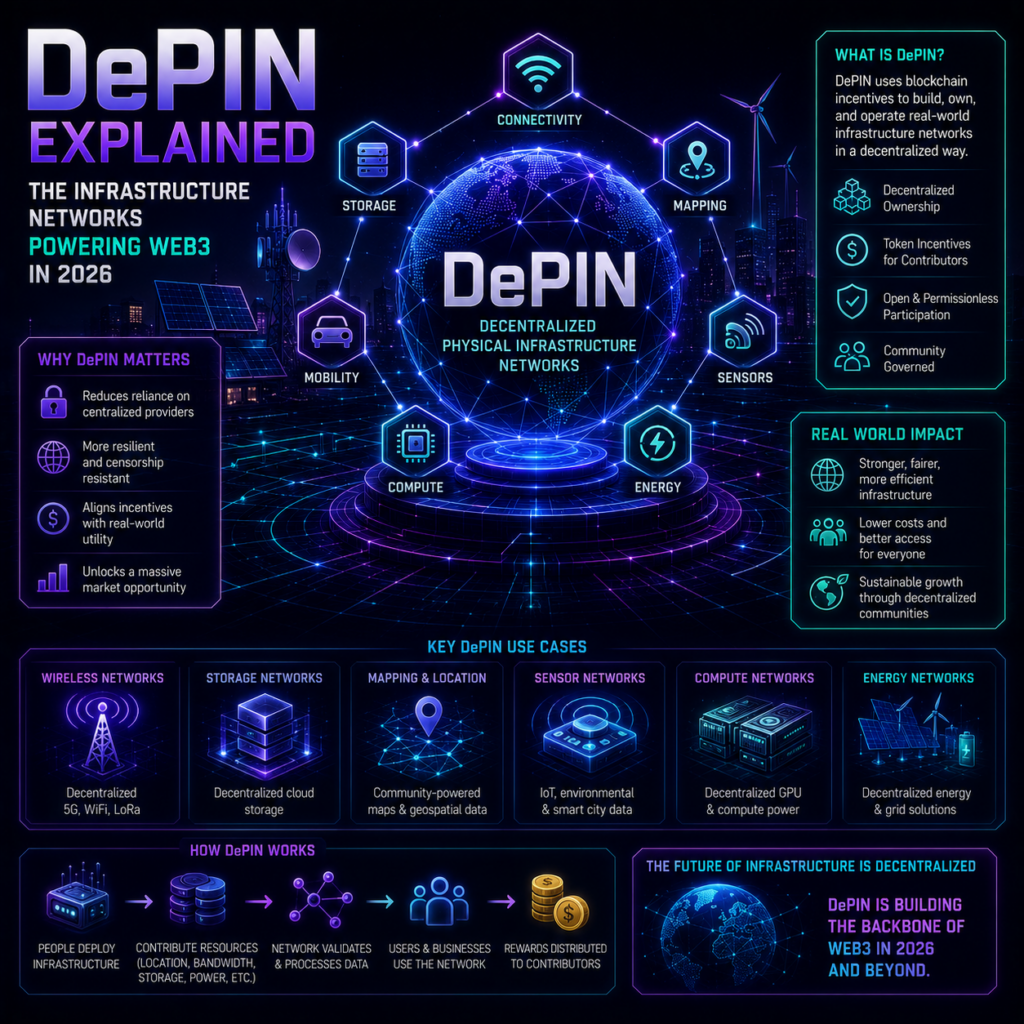
The short answer to what is DePIN crypto infrastructure: it is a way of building physical networks by paying strangers in tokens to install the hardware. Instead of a company raising capital and deploying equipment itself, the protocol issues tokens to whoever puts a device somewhere useful and proves it is working. The interesting question in 2026 is not whether that model can deploy hardware, because it demonstrably can. It is whether anyone is paying to use what got deployed. This piece covers the mechanism, three real networks with sourced numbers, and where the data gets murky. Key Takeaways The short answer to what is DePIN crypto: Decentralized Physical Infrastructure Networks, swapping capital expenditure for token incentives. DePINscan tracked 440 projects, 40.9 million devices and $6.46 billion in combined market cap on 27 August 2026. Helium reports 140,000+ community-deployed hotspots and daily carrier data growing from about 24 TB to roughly 128 TB over a year. GEODNET operates more than 21,000 satellite positioning stations across 160+ countries. Device counts and market cap figures differ substantially between trackers, so treat any single number with caution. What is DePIN crypto infrastructure, mechanically Traditional infrastructure has a bootstrapping problem. A wireless carrier must build coverage before anyone will pay for it, which means enormous upfront spending against uncertain demand. DePIN inverts the sequence. The protocol issues tokens to hardware operators for verified contribution, so the network gets built by thousands of individuals each spending a few hundred dollars, and the protocol pays them in a token whose value depends on the network eventually being useful. Three components make it work. A physical device doing something measurable. A proof mechanism confirming the device genuinely provides the service rather than faking it, which is the hard engineering problem. And a token that rewards verified contribution and, in better designs, is consumed when customers pay. That last point separates the models worth examining from the rest. If tokens only flow outward to operators, the network is subsidising itself. If customer payments burn or capture tokens, there is a demand loop. Our piece on AI and smart contracts in 2026 covers the automation layer that makes this coordination practical at scale. What is DePIN crypto in practice: three networks Helium, decentralized wireless. Helium’s own network snapshot reports more than 140,000 community-deployed hotspots, with live carrier partnerships in the USA and Mexico and expansion underway in Brazil. The most useful figure is the growth in carrier traffic: from roughly 24 TB per day in June 2025 to about 128 TB per day in May 2026, which Helium describes as real subscriber traffic routed by carriers rather than test volume. Daily active users are charted from 1.4 million in Q2 2025 to 3.4 million in Q1 2026. Helium also states that verified carrier data permanently burns HNT, which is the demand loop described above. In June 2026, Helium Mobile was acquired by Noble Mobile, leaving the Helium team focused on carrier infrastructure. Akash and Filecoin, compute and storage. According to DePINscan on 27 August 2026, Filecoin carried a $628.5 million market cap against 1,308 tracked devices, and Akash $166.6 million against 361. Those device counts look small next to consumer networks because each unit is a data centre node rather than a household gadget, which is worth remembering when device totals get quoted as a measure of scale. GEODNET, satellite positioning. DePINscan lists GEODNET at a $109.8 million market cap with 22,510 tracked devices, and its June 2026 coverage reports more than 21,000 GNSS base stations across over 160 countries providing centimetre-level positioning for agriculture, drones and autonomous vehicles. It is the clearest example of DePIN building something with an obvious non-crypto customer. Where the numbers get murky This is the part most explainers skip. On 27 August 2026, DePINscan reported 440 projects, 40,929,518 devices and $6.46 billion in combined market cap. CoinGecko’s DePIN category showed roughly $7.82 billion on the same day, and other trackers have published figures around $19 billion using wider definitions. None of these is wrong exactly. They count different things. Even single sources disagree with themselves. Helium’s snapshot page headlines both “1 Million+” daily users and a chart showing 3.4 million, and both “49 TB+” and roughly 128 TB of daily data, apparently reflecting different periods or different measures without saying which. That is not evidence of bad faith. It is evidence that this sector’s reporting conventions are immature, and that anyone answering what is DePIN crypto worth should quote a source and a date rather than a number. The supply and demand gap The pattern across the sector is consistent, and it is the real answer to what is DePIN crypto delivering today. Supply-side metrics are impressive: tens of millions of devices, hundreds of projects, real geographic coverage. Demand-side metrics are much thinner, and that gap is the whole question. Helium is the most interesting case precisely because its carrier traffic figure is a demand number rather than a deployment number. Someone is paying to route subscriber data. Most DePIN networks cannot yet point to an equivalent. When assessing any project in this sector, the question to ask is not how many nodes exist but who is paying for the output, how much, and whether that revenue reaches the token. For more on where compute pricing sits, see our DePIN and AI coverage. Disclaimer: This article is for informational and educational purposes only and is not financial or investment advice, and no project mentioned is endorsed. Token prices are volatile and hardware deployment carries capital and operational risk with no assured return. Network statistics are self-reported or tracker-derived and change constantly. Do your own research and consider speaking to a qualified professional. See our editorial policy for how we source and verify our reporting. Final Thoughts DePIN is one of the few areas of crypto where the output is inspectable without any belief in the token. You can check whether coverage exists, whether positioning data is accurate, whether storage is retrievable. That
What Are Real-World Asset (RWA) Tokens and Why Institutions Are Buying In

The phrase doing the most work in this sector is “backed”, and it is rarely examined. When people discuss real world asset tokens crypto markets have embraced, they mean a token representing something off-chain: a Treasury bill, a gold bar, a pool of private loans. What that representation legally entitles you to varies enormously between products, and the difference is not visible in the price. This piece sets out the mechanism, what it does and does not guarantee, and institutional examples running live in 2026. Key Takeaways DefiLlama tracked $31.7 billion in active RWA market cap across 217 asset issuers on 27 August 2026. BlackRock’s BUIDL, tokenized by Securitize, was the largest tokenized money market fund at $2.79 billion. Being “backed” means holding a legal claim against an issuer, not owning the underlying asset directly. Redeemability, published attestations and transfer restrictions differ product by product and are checkable. Most institutional RWA products are permissioned, requiring identity verification to mint, redeem or hold. Real world asset tokens crypto buyers hold: what “backed” means The mechanism is less exotic than the terminology suggests. An issuer, usually a fund or a special purpose vehicle, holds the real asset. It then issues tokens on a blockchain representing shares in that vehicle or a debt claim against it. The blockchain becomes the register of who owns what, replacing or mirroring a traditional transfer agent. So a token is not the asset. It is a claim on an entity that holds the asset, and the strength of that claim depends entirely on the legal wrapper around it. This distinction matters most in the scenario that never appears in marketing material: what happens if the issuer fails. Your recourse is against the issuing entity under whatever law governs it, exactly as with a conventional fund share, and the blockchain does nothing to improve it. Two structures dominate. The first is a tokenized regulated fund share, where a fund records its shares on-chain and the token is the share. The second is a debt token issued by an offshore vehicle holding the underlying instruments and promising redemption. Both are legitimate. They are not the same instrument and do not carry the same protections. What tokenization does and does not guarantee It delivers three things. Settlement is faster and can run outside banking hours. Holdings become composable, so a token can be posted as collateral elsewhere without converting back to cash. And ownership records become continuously visible rather than reconciled periodically. What it does not do is more important for anyone evaluating real world asset tokens crypto platforms are listing. Tokenization does not create a legal right that was not written into the documents. It does not guarantee redemption at par, or at all, unless the issuer has contracted to provide it. It does not verify that the underlying asset exists, which is what attestations are for. And it does not make an illiquid asset liquid: tokenizing a building does not create buyers for it. DefiLlama’s RWA dashboard makes these differences unusually easy to check, because it tracks them as fields per product: whether the token is redeemable, whether attestations are published, whether it is permissioned, and whether KYC is required to mint, redeem or transfer. Those four columns tell you more about what you actually hold than any yield figure. The market as it stands in 2026 On 27 August 2026, DefiLlama recorded total RWA active market capitalisation of $31.7 billion, on-chain market cap of $34.6 billion, across 217 asset issuers. DeFi active TVL from those assets was $3.84 billion, which tells you most real world asset tokens crypto holders own sit held rather than circulating in protocols. The composition is instructive. Tether Gold led individual assets at $3.24 billion, then Circle’s USYC at $2.88 billion and BlackRock’s BUIDL at $2.79 billion. Private credit appears through Maple’s syrupUSDC at $1.24 billion, with far higher DeFi utilisation at 47%. Our coverage of why tokenized real-world assets matter and bank adoption of tokenization covers the wider trend. Two institutional examples, checked BlackRock BUIDL. The USD Institutional Digital Liquidity Fund, tokenized by Securitize, held $2.794 billion in active market cap on 27 August 2026 per DefiLlama, with a separate I Class at $698 million. The structural detail worth noting: DefiLlama lists it as permissioned, redeemable, requiring KYC both to mint or redeem and to transfer or hold, and without published attestations. That combination is typical of institutional products and is the opposite of the permissionless model most crypto holders assume. Franklin Templeton BENJI. The Franklin OnChain U.S. Government Money Fund appears at $682 million, alongside the Franklin OnChain Institutional Liquidity Fund at $1.52 billion. Unlike BUIDL, both are listed with attestations published. Same asset class, different disclosure posture, and exactly the variation that gets flattened when real world asset tokens crypto coverage treats them as one category. DTCC, as a forward example. The Depository Trust and Clearing Corporation announced on 12 May 2026 that its Collateral AppChain will use Chainlink’s Runtime Environment and data standard for pricing, valuation and settlement, with go-live expected in Q4 2026. That is announced infrastructure rather than a live product and should be described that way. DTCC’s subsidiaries processed $4.7 quadrillion in securities transactions in 2025, so the direction of travel matters even though the platform is not running yet. Elsewhere, Chainlink’s Q2 2026 quarterly review, published 24 July 2026, reports that Fidelity International launched its first tokenized fund, FILQ, and that State Street and Galaxy launched SWEEP, a tokenized liquidity fund. Both are reported by the infrastructure provider rather than by the asset managers directly, which is worth knowing when weighing the claim. What to check before treating a token as backed Four questions, in order. Who is the issuing entity, and under which jurisdiction’s law does your claim sit? Is the token redeemable, and by whom, since many institutional products restrict redemption to qualified holders? Are attestations published confirming the underlying assets exist? And what transfer restrictions apply, since a permissioned token you
AI Smart Contracts 2026: How Oracles Are Making Code Smarter

Chainlink, the dominant decentralized oracle network, secures more than $61 billion in assets and has processed over $29 trillion in cumulative transaction value as of early 2026, per data from Chainlink’s network telemetry. In November 2025, the project shipped the Chainlink Runtime Environment (CRE) — the infrastructure that connects onchain smart contracts to offchain AI computation. By February 2026, Virtuals Protocol launched its Revenue Network with the Agent Commerce Protocol, processing $200,000 in USDC within 48 hours of go-live. AI smart contracts are no longer theoretical. They are shipping, generating revenue, and quietly reshaping what “smart” actually means in smart contracts. The honest framing: smart contracts themselves cannot run AI models. Blockchains lack the compute, storage, and external data access that AI requires. By contrast, AI is becoming integrated with smart contracts through three concrete mechanisms — oracle networks delivering verified AI outputs onchain, agent-execution layers using contracts as their settlement rails, and verifiable off-chain computation environments like Chainlink CRE. This piece breaks down how each of these works in practice, names the projects actually shipping it, and explains where the architecture still hits real limits. Why Smart Contracts Cannot Run AI Directly The first thing to get right: smart contracts as currently designed cannot execute AI models. Three structural reasons make this clear. First, compute cost. Running an LLM inference or any non-trivial machine learning model consumes processing power that would cost thousands of dollars in gas fees on Ethereum mainnet for a single execution. Even on cheaper L2s, the cost is prohibitive. Second, determinism. Blockchains require every node to reach the same result. AI models, particularly LLMs, can produce non-deterministic outputs. Running them onchain would break consensus. Third, data access. Smart contracts cannot natively access external APIs, real-time data feeds, or the broader internet — the inputs AI typically needs. By contrast, AI without external data is essentially a static lookup table. The result: every “AI smart contract” architecture in 2026 routes AI computation offchain, then uses oracles or verifiable computation to bring the result onchain in a trust-minimized way. That is what’s actually shipping. Oracles: The Bridge Between AI Models and Smart Contracts Chainlink remains the dominant infrastructure for this. The network secures more than $61 billion in assets across DeFi and tokenized real-world assets, with the Cross-Chain Interoperability Protocol (CCIP) seeing monthly volumes climb 62% year-over-year to $18 billion in early 2026, per Chainlink’s network data. Beyond traditional price feeds, three Chainlink products specifically enable AI smart contract integration: Chainlink Functions — allows smart contracts to call arbitrary APIs and computations. AI model outputs from external providers can be requested by a contract, computed off-chain, and returned with cryptographic attestation. Chainlink Runtime Environment (CRE) — published November 4, 2025 and updated through February 2026, CRE powers the connection between onchain smart contracts and offchain AI capabilities. Five named use cases ship today: stablecoin workflows, tokenization orchestration, AI prediction markets, agent-driven triggers, and custom data feeds. Multi-LLM aggregation — Chainlink can aggregate responses from multiple large language models via the oracle network to enhance AI decision reliability, addressing the determinism problem by reaching consensus across multiple model outputs. The institutional traction is real. In early 2026, Chainlink partnered with 24 major banks to deploy AI oracles tackling a $58 billion global data crisis — extracting and verifying unstructured financial data from PDFs and other formats using AI models, then achieving 100% consensus through decentralized verification. Per CryptoNews reporting from April 2026, this positions Chainlink as the infrastructure layer for institutional-grade AI agent activity. By contrast, the LINK token itself trades near $9.41 as of April 18, 2026 — well below its 2025 highs near $30.95. Network utility and token price have diverged considerably. CCIP volume up 62% YoY while LINK is down ~70% from peak is the cleanest example in crypto of the gap between infrastructure adoption and token speculation. Agent Execution Layers: Smart Contracts as the Settlement Rail The second major shift: autonomous AI agents are using smart contracts as their execution and settlement layer. Virtuals Protocol is the cleanest live example. As of February 2026, Virtuals had deployed over 18,000 AI agents with $477 million in cumulative agentic GDP, per AInvest data referencing Virtuals’ own metrics. Monthly protocol revenue ran at $2.63 million in the same window. The biggest 2026 development was the launch of Virtuals Revenue Network on February 12, 2026 — the first onchain network where autonomous AI agents can discover, negotiate, execute, and settle payments with each other using the Agent Commerce Protocol (ACP). A sub-product within the network processed $200,000 in USDC within 48 hours of launch, per PR Newswire reporting from Consensus Hong Kong. In Virtuals’ architecture, the AI model runs offchain. The smart contract handles the agent’s wallet, the negotiation logic, the settlement, and the verification that all parties agreed. The token (VIRTUAL) coordinates the economic layer. Remove the contract, the agent has nowhere to settle. Remove the AI, the contract is just a basic escrow. The combination is what makes the system work. Beyond Virtuals, the broader top AI agent crypto cohort in 2026 — per Blockchain Council’s category aggregation — includes Chainlink (LINK) for oracles, the Artificial Superintelligence Alliance (FET/ASI) for agentic AI consolidation, Kite (KITE), tokenbot (CLANKER), Bittensor (TAO) for decentralized AI compute, The Graph (GRT) for indexing, and iExec (RLC) for decentralized cloud computing. Each fills a different role in the AI/smart-contract stack rather than competing directly. Verifiable Off-Chain Computation: The Trust Bridge The third architecture matters most for institutional adoption: how do you trust that the AI computation happening offchain produced the result the smart contract is now acting on? Chainlink Functions implements what Chainlink describes as a “request-compute-attest-respond loop”: a smart contract requests an off-chain computation; a decentralized oracle network performs it; the result is returned onchain with cryptographic attestation that the computation followed the specified logic, per academic analysis of Chainlink architecture (arXiv 2601.04583, 2026). Other approaches in production: Oraichain integrates AI APIs directly into smart contracts for on-chain inference, combining
DePIN x AI 2026: The Five Networks Undercutting AWS by 70%

Decentralized Physical Infrastructure Networks (DePIN) held a combined market cap of $9-10 billion across roughly 250 active projects in early 2026, per CoinGecko data. The five largest by market cap as of May 2026: Bittensor (TAO) at $3.12 billion, Internet Computer (ICP) at $1.50 billion, Render Network (RENDER) at $1.24 billion, Filecoin (FIL) at $811 million, and BitTorrent (BTT) at $317 million, per Spoted Crypto’s sector guide. By contrast, the real story isn’t the market caps — it’s the revenue. Render generated $38 million in monthly revenue in January 2026. Aethir delivered $127.8 million in 2025 revenue from enterprise AI and gaming clients. Akash crossed $5 million in compute spend in Q1 2026, an all-time high. These networks are no longer subsidizing supply with token emissions. They are billing real customers for real compute, and they are doing it at 70% below AWS pricing. The honest setup: a NVIDIA H100 hour at AWS, Google Cloud, and Azure floats in the $4.50-$5.50 range, per DEXTools market analysis. The same hour on IO.NET runs 50-70% lower. Akash benchmarks 70-85% savings versus AWS SageMaker. Render delivers H200 and H100 GPUs at $1.75 per compute hour. This piece breaks down the five DePIN x AI networks actually shipping revenue in 2026, the architecture each runs, and where the model still hits real limits. Why DePIN Suddenly Matters for AI The NVIDIA H100 shortage that began in 2023 has become the defining bottleneck of the AI economy, per DEXTools’ February 2026 analysis. Hyperscaler waiting lists stretch into quarters. On-demand H100 access at AWS, Google Cloud, and Azure prices at $4.50-$5.50 per hour. For founders building generative models, autonomous agents, or production AI inference, that ceiling is a strategic problem — and DePIN is the only credible alternative producing revenue at scale. The sector has restructured around two pillars per KuCoin’s March 2026 analysis: Physical Resource Networks (PRN) like Hivemapper for geospatial data and Helium for wireless, and Digital Resource Networks (DRN) like Render and Akash for compute. AI almost exclusively drives DRN demand, where resources are fungible and location-agnostic. Industry-tracked subcategories in 2026 now include nine distinct areas: AI compute, GPU compute, cloud compute, storage, wireless, bandwidth, data indexing, geospatial/mapping, and sensor/IoT. The bigger structural shift: DePIN’s revenue model has changed. Per BlockEden’s April 2026 analysis, the early growth model paid suppliers in tokens to bootstrap supply. Filecoin paid storage providers in FIL. Akash paid GPU providers in AKT. This produced infrastructure capacity without answering who was actually paying for it. In Q1 2026, that question finally has an answer — enterprise customers are buying AI compute, storage, and inference at scale, and the leaders are now generating demand-driven revenue rather than emissions-driven supply growth. Render Network: $38M Monthly Revenue, Hollywood and AI Render is the clearest example of DePIN producing real revenue. The network generated $38 million in monthly revenue in January 2026, ranking second globally among all DePIN projects, per BlockEden. The operational footprint: 5,600 active GPU nodes across the network 67 million+ cumulative frames rendered H100 and H200 GPUs at $1.75 per compute hour (vs AWS $4.50-$5.50) 600+ open-weight AI models supported via OTOY Studio Hollywood studio clients responsible for 35% of 2025 output Coca-Cola activation on the Las Vegas Sphere NASA content for the International Space Station Market cap: $1.24 billion (May 2026, ranked #3 in DePIN) The strategic move: in December 2025, Render launched Dispersed.com, an AI compute subnet aggregating distributed GPUs specifically for machine learning workloads. Originally built for 3D rendering, the network pivoted aggressively into AI inference — and the revenue figures suggest the pivot is working. By contrast, the RENDER token has not recovered its 2024 highs despite the revenue growth. The market cap-to-revenue ratio remains historically wide. Akash Network: 85% Cheaper Than AWS, Named Enterprise Customers Akash positions itself as the “Airbnb for cloud computing” — a reverse-auction marketplace where GPU providers compete for developer workloads, driving prices well below hyperscalers. The Q1 2026 numbers, per Messari and Akash’s own quarterly report: $5 million in Q1 2026 compute spend — network all-time high 43,540 active leases (+27.1% quarter-over-quarter) H100 access at $1.20-$1.80 per hour (vs AWS $4.50-$5.50) — 70-85% savings AkashML inference at $2-$4 per million tokens (vs OpenAI’s $15) Named customers: Venice, ElizaOS, Morpheus, Gensyn Burn-Mint Equilibrium (BME) live March 23, 2026 — burns AKT proportional to compute spend 53,520 AKT burned in 9 days after BME launch (~5,950 AKT daily average) Homenode Beta launched Q1 — consumer GPUs (RTX 4090, 5090, Quadro RTX 6000 Ada) The honest counterweight: per Messari’s Q1 2026 report, lease revenue actually fell 45% quarter-over-quarter to $253,250 despite lease growth — reflecting intense price competition that has squeezed provider margins. Active providers fell to 58 in Q1 2026, the lowest in network history. By contrast, the network-wide compute spend grew because customers shifted to cheaper workloads. Strong demand, weak unit economics. That tension defines the Akash investment case right now. IO.NET: 100,000 GPUs on Solana, Built for Ray IO.NET takes a different architectural bet: aggregate 100,000+ idle GPUs across the Solana ecosystem, schedule them with Ray (the open-source distributed compute framework), and rent AI clusters at 50-70% below AWS, per DEXTools’ May 2026 analysis. The differentiation is workload fit — IO.NET is purpose-built for AI teams that already use Ray and value cluster scale and supplier diversity over enterprise SLAs. By contrast, IO.NET trades enterprise predictability for raw cost compression. Workloads benefit from massive supplier diversity, but the trade-off is harder service-level guarantees compared to Aethir’s enterprise-contract model. For teams running model training that can tolerate variable provider quality, the economics are compelling. For teams running production inference at consumer scale, the path is less clear. Aethir: $127.8M in Enterprise Revenue, the Hidden Leader Aethir is the under-covered story. Per KuCoin’s sector analysis, Aethir delivered $127.8 million in 2025 revenue from enterprise AI and gaming clients — making it the #1 DePIN by enterprise revenue. The network has delivered over 1.5 billion compute hours. Per Aethir’s internal disclosures, its
ML for Crypto Risk Management 2026: When GARCH Still Wins

A 2026 study published in Modern Finance tested machine learning models against classical GARCH-family models for cryptocurrency volatility forecasting across 10 major cryptocurrencies, using daily data from June 2020 to June 2025 under a strict walk-forward evaluation protocol. The finding: traditional GARCH models perform adequately for stable assets like Bitcoin and Ethereum, where volatility clustering persists. For sentiment-driven assets like Dogecoin, Shiba Inu, and Toncoin, GARCH accuracy drops sharply — and ML models (particularly GRU and TDNN architectures) take over. The honest 2026 picture: machine learning has not replaced classical risk management. It has carved out the parts of the market where classical methods break down. This piece breaks down where ML actually wins in crypto risk management, where it still loses to GARCH, the four ML position-sizing methods professional desks use in 2026, the mathematics behind the 1% rule, and the specific limits — overfitting, regime change, model brittleness — that should keep human oversight in the loop. The 2022 bear market lessons still apply: the effectiveness of a risk management framework depends on disciplined application, not model sophistication. The 2026 Volatility Forecasting Verdict Six independent academic studies between 2023 and 2026 converge on roughly the same finding: hybrid models combining GARCH with deep learning outperform either approach alone for crypto volatility forecasting. The hierarchy that has emerged: GARCH and EGARCH remain the strongest standalone classical models, especially for BTC and ETH where volatility clustering is persistent Random Forest and LSTM significantly outperform GARCH on volatile sentiment-driven assets (DOGE, SHIB, TON), per a ScienceDirect study testing internal and external determinants GRU and TDNN beat both LSTM and FFNN on error rates per the Modern Finance 2026 walk-forward study Hybrid GARCH-LSTM and GARCH-GRU models achieve the most accurate and statistically significant forecasts overall The mechanism: GARCH-family models are excellent feature extractors for volatility clustering, but they struggle with nonlinear dynamics. Deep learning models capture the nonlinearities but benefit from GARCH-generated features as inputs. Studies feeding GARCH, EGARCH, and APGARCH outputs into DFFNN and LSTM networks consistently show improvements over either approach alone, across 27 cryptocurrencies tested. By contrast, the practitioner reality is more conservative. Most production risk management systems in 2026 still use GARCH or EGARCH as the primary volatility estimator, with ML overlays for specific asset classes (memecoins, low-cap altcoins) and specific use cases (regime detection, correlation forecasting) where the classical models underperform. Where ML Wins: Sentiment-Driven Assets and Regime Detection The Modern Finance 2026 study’s most actionable finding: for Dogecoin, Shiba Inu, Toncoin, and similar narrative-driven assets, GARCH forecasting accuracy drops sharply because volatility patterns deviate from the clustering assumption GARCH is built on. ML models — particularly GRU networks combined with sentiment inputs — capture these dynamics better. Three specific applications where ML genuinely outperforms in 2026: Volatility regime detection. Hidden Markov Models and clustering-based ML approaches identify shifts between low-volatility, high-volatility, and crisis regimes faster than classical models. This matters because position sizing rules that work in low-vol regimes will produce inappropriate exposure when conditions shift. Time-varying correlation forecasting. During market stress, crypto correlations spike — often to 0.85-0.95 between major assets. ML correlation forecasting captures these regime shifts before they fully materialize, allowing portfolio rebalancing that reduces systemic risk. Sentiment-conditioned volatility. Natural language processing on news, social media, and on-chain governance discussions provides leading indicators for volatility on assets where price action is sentiment-driven rather than fundamental. The combination of sentiment features with GARCH baseline produces forecasts that classical models alone cannot generate. The Four ML Position Sizing Methods Per Blockchain Council’s April 2026 framework, professional ML-driven risk management implements four position sizing methods that adapt continuously to market conditions rather than relying on fixed percentages. Volatility targeting. Size positions so that expected volatility contribution stays near a target level. When realized or forecasted volatility rises, position size goes down. The most common implementation: estimate near-term volatility, set maximum risk per trade as a percentage of equity (typically 0.25%-1%), and compute position size so that the stop-loss distance corresponds to that risk amount. Equity-based scaling. Adjust size based on current account balance and drawdown status. After a string of losses, the system reduces position size automatically to preserve capital during what may be a bad regime. The math is unforgiving: a 10% drawdown requires an 11% gain to recover; a 50% drawdown requires a 100% gain. Correlation-aware limits. Reduce combined exposure when assets become highly correlated. In 2026, with memecoin and AI sector tokens often moving in lockstep, portfolios that look diversified on paper can have effective correlation above 0.8. ML-driven correlation monitoring caps combined exposure to correlated baskets rather than just individual positions. Liquidity-aware sizing. Cap position size based on order book depth to reduce slippage and market impact. For altcoins, this often binds tighter than volatility or equity constraints — taking the volatility-implied size on a thin-liquidity token would cause meaningful price impact even before any market move. The Math of the 1% Rule Per Cryptorobot.ai’s April 2026 framework, professional algorithmic traders converge on roughly the same range: 1-2% risk per trade as the widely accepted ceiling, with 0.25-1% common for institutional systems. The math explains why this range is non-negotiable. If a trader risks 2% per trade and experiences 10 consecutive losses (which any strategy will eventually do over enough trades), the cumulative drawdown is approximately 18% — uncomfortable but recoverable. The required gain to break even is roughly 22%. By contrast, if the same trader risks 10% per trade, 10 consecutive losses produce a 65% drawdown, requiring a 186% return to recover. The fundamental problem: drawdowns are asymmetric. A 50% loss requires a 100% gain to return to breakeven. A 65% loss requires a 186% gain. ML systems formalize this by maintaining strict drawdown controls. Portfolio-level constraints typically cap maximum drawdown at 20-25% by automatically reducing exposure when losses approach the threshold. Asset-level limits cap individual positions at 10-15% of total portfolio value, preventing single-asset concentration from creating unrecoverable losses. These constraints are deliberately tighter than what discretionary traders typically
What Are AI Tokens in Crypto? The 5 Layers That Matter in 2026

The phrase covers too much ground to mean anything on its own. Ask what AI tokens in crypto 2026 actually are and the honest answer is that they are at least five different things with different economics, different customers and different reasons to exist. A GPU rental marketplace and a chatbot-themed memecoin both appear in the same category on every tracker. This piece separates them using the taxonomy the data providers themselves use, with current market values for each layer. Key Takeaways CoinGecko splits its AI category into sub-categories including AI Agents, AI Applications, AI Framework, DeFAI and Bittensor Subnets. Compute networks, model networks, data infrastructure, agent platforms and AI-oriented base layers behave as five distinct groups. The two largest entries, NEAR at $2.54 billion and Bittensor at $2.22 billion, sit in different categories entirely. Compute networks are the easiest to evaluate because their output is a measurable service. Which layer a token occupies tells you more about its risk than the AI tokens in crypto 2026 label ever will. Why one label for AI tokens in crypto 2026 fails Tracker categories are broad by design. CoinGecko’s AI category held 1,448 tokens on 1 September 2026, and its own interface breaks that into sub-groups: AI Agents, AI Applications, AI Framework, AI Agent Launchpad, Bittensor Subnets, DeFAI and the Virtuals Protocol ecosystem. That segmentation exists because the underlying businesses have almost nothing in common. Grouping them produces a sector average that describes none of them. The useful unit of analysis is the layer, not the label, and understanding AI tokens in crypto 2026 means starting there. Layer one: compute networks The most straightforward group. These networks rent out processing capacity, usually GPUs, and the token pays for access or rewards suppliers. On CoinGecko’s data for 1 September 2026, Render sat at $749 million market cap, Aethir at $98 million, Akash at $154 million and io.net at $50 million. These are the easiest of the AI tokens in crypto 2026 to assess, because the product is a commodity service with an external price. You can ask what equivalent capacity costs elsewhere and whether anyone is actually renting. That is harder for most of the sector, which is why this layer attracts the more rigorous analysis. Our DePIN and AI coverage looks at compute pricing specifically. Layer two: model and intelligence networks Rather than renting hardware, these coordinate the production of machine learning output itself. Bittensor is the dominant example at $2.22 billion, and it has spawned an entire sub-economy: CoinGecko maintains a separate Bittensor Subnets category, with individual subnet tokens including Chutes at $101 million, Targon at $72 million and Score at $48 million appearing in the main listing. This layer is harder to evaluate. The output is intelligence quality, which has no external spot price, so assessment depends on whether the network’s internal incentive mechanism actually rewards useful work rather than gaming. That is a live debate rather than a settled question. Layer three: data infrastructure Machine learning needs data pipelines, and several long-running projects occupy that ground. CoinGecko’s 1 September figures put Grass at $238 million, The Graph at $181 million, Arweave at $137 million and Ocean Protocol at $34 million. Some of these predate the AI narrative by years. The Graph indexes blockchain data and Arweave provides permanent storage, both built for reasons unrelated to machine learning. They appear among AI tokens in crypto 2026 listings because their function is useful to AI systems, which is a legitimate reclassification but worth knowing when a token is presented as a new AI play. Layer four: agent platforms The newest group, and the one driving most of the current excitement. These support autonomous programs that hold funds and transact on-chain. Virtuals Protocol stood at $461 million and the Artificial Superintelligence Alliance at $354 million on the same date, with CoinGecko maintaining dedicated AI Agents and AI Agent Launchpad categories. This layer carries the widest quality range. Launchpads make it trivial to issue an agent-themed token, so the category contains both serious infrastructure and assets whose connection to autonomous systems is thematic. Checking which is which matters more here than anywhere else in AI tokens in crypto 2026 listings. Layer five: base layers positioning around AI Finally, general purpose blockchains that have oriented their roadmaps toward AI workloads. NEAR at $2.54 billion and Internet Computer at $1.34 billion are the largest entries in CoinGecko’s AI category, and both are layer-one networks rather than AI-specific products. Their inclusion is defensible and it distorts sector averages. The largest of the AI tokens in crypto 2026 rankings is a general purpose chain, which is worth remembering when a headline category figure is quoted as if it measured AI-specific businesses. How to place a token yourself Three questions settle it. What is the token actually paid for: compute time, model output, data access, agent transactions, or gas on a general chain? Does the service have an external price you can compare against a non-crypto alternative? And was the project built for AI or reclassified into it? The answers change the risk profile substantially. A compute network competing on price against conventional providers faces a different problem from an agent platform competing on novelty. Our coverage of how artificial intelligence is reshaping blockchain and of AI and smart contracts covers the technology underneath. Disclaimer: This article is for informational and educational purposes only and is not financial or investment advice, and no token or category is endorsed. Categorisation is descriptive, not a quality judgement, and tracker classifications vary between providers. Crypto prices are volatile and you may lose money. Market data changes constantly, so verify current figures before relying on any of it. See our editorial policy for how we source and verify our reporting. Final Thoughts The most useful thing to know about AI tokens in crypto 2026 is that the label is a filing convenience rather than a description. Five layers sit underneath it, and a token’s layer tells you what it competes against,
The Rise of Autonomous Crypto Agents Could Transform Market Strategies

The crypto market has always moved quickly, but a new development is starting to push the pace of change even further. Autonomous crypto agents are emerging as one of the most interesting trends in digital assets, combining artificial intelligence, automation, and blockchain infrastructure into systems that can act with increasing independence. While the concept may still sound futuristic to some investors, the foundations are already being built, and the implications for trading, portfolio management, and market strategy could be significant. For years, crypto strategies have relied on a mix of human decision-making, algorithmic trading, and increasingly advanced analytics. Traders have used bots, scripts, and automated tools to execute orders faster or monitor markets around the clock. Autonomous crypto agents take this idea much further. Instead of following only rigid instructions, these systems are being designed to observe information, interpret conditions, make decisions, and carry out actions with minimal human input. This shift matters because it changes how market participants may approach strategy itself. Rather than simply reacting to price charts or news events, investors could increasingly rely on intelligent systems that continuously adapt, optimize, and interact with blockchain-based environments in real time. If this trend continues to develop, it may transform not just how trades are executed, but how entire market strategies are designed. What Autonomous Crypto Agents Actually Are At a basic level, autonomous crypto agents are software systems designed to perform blockchain-related tasks with a degree of independence. They are not limited to simple automated triggers like a standard trading bot that buys when a price hits a specific level. Instead, they can combine data inputs, AI models, on-chain interaction, and goal-driven behavior to make more flexible decisions. These agents can potentially analyze social sentiment, monitor wallet activity, track liquidity shifts, compare opportunities across multiple protocols, and execute transactions based on changing market conditions. In some cases, they may also coordinate with smart contracts, treasury systems, or decentralized applications without requiring a user to manually approve every step in a process. This makes them different from older forms of automation. Traditional bots follow rules. Autonomous agents are moving toward interpretation and adaptation. That distinction may become increasingly important as the crypto market grows more complex and competitive. Why This Trend Is Gaining Attention Now The rise of autonomous crypto agents is happening at a time when several major trends are beginning to overlap. Artificial intelligence has become one of the most closely watched technology themes in the world. At the same time, blockchain infrastructure is becoming more capable, more scalable, and more integrated with different kinds of applications. DeFi platforms, on-chain analytics, tokenized systems, and programmable assets are all creating environments where digital agents can operate more effectively. The crypto market also produces a huge volume of data. Prices change constantly, sentiment shifts rapidly, and on-chain behavior can signal important developments before they appear elsewhere. Human traders can monitor some of this, but not all of it at once, and not with the same speed as an intelligent automated system. Autonomous agents are gaining attention because they seem well suited to exactly this kind of environment. Another reason this trend is drawing interest is that crypto already has a strong culture of experimentation. New tools, models, and protocols are often tested quickly. As a result, autonomous agents are not emerging in a passive ecosystem. They are being introduced into a market that is already comfortable with automation, open-source development, and new forms of financial behavior. Trading Strategies Could Become More Adaptive One of the clearest areas where autonomous agents could have an impact is trading strategy. In traditional crypto trading, even sophisticated participants often rely on a defined system that is periodically updated by human operators. A trader may adjust models, change risk settings, or switch strategies based on experience and market conditions. Autonomous agents could make that process far more dynamic. Instead of waiting for manual review, an intelligent agent could continuously update its assumptions based on incoming information. It could identify when volatility is increasing, when liquidity is thinning, or when sentiment across specific sectors is shifting. It could then modify behavior in response, reducing exposure, rotating between assets, or choosing different execution patterns. This type of adaptability could reshape how traders think about edge. In the past, having a faster bot or better indicator might have been enough. In the future, the advantage may come from having an agent that can learn, prioritize, and act more intelligently than static systems. That could raise the level of competition across the market and encourage a broader move toward AI-driven trading infrastructure. Portfolio Management May Become More Automated The influence of autonomous crypto agents may go beyond active trading. Portfolio management could also change in meaningful ways. Many investors already use tools to rebalance holdings, monitor risk, or track performance, but these tasks still often require regular oversight and manual intervention. A more advanced agent could potentially manage a portfolio according to broader goals rather than narrow instructions. For example, it could maintain target risk exposure, shift capital between stablecoins and higher-beta assets, monitor staking opportunities, or adjust yield strategies based on market conditions. Rather than simply following a calendar-based rebalance, it could make context-aware adjustments. For retail investors, this could make complex strategies more accessible. For more advanced participants, it could reduce operational friction and improve speed. In both cases, the core idea is the same: market strategies become less about one-time setup and more about continuous intelligent management. DeFi Could Be One of the Biggest Beneficiaries Decentralized finance may be one of the most important environments for autonomous agents to operate in. DeFi is already highly programmable. Users can lend, borrow, swap, stake, provide liquidity, and move capital across protocols without traditional intermediaries. This makes it a natural setting for software systems that can act on behalf of users or organizations. An autonomous agent in DeFi could search for better yields, manage collateral positions, monitor liquidation risks, or optimize capital allocation across multiple protocols. It
AI Crypto Trading Bots 2026: What the Regulators Actually Found
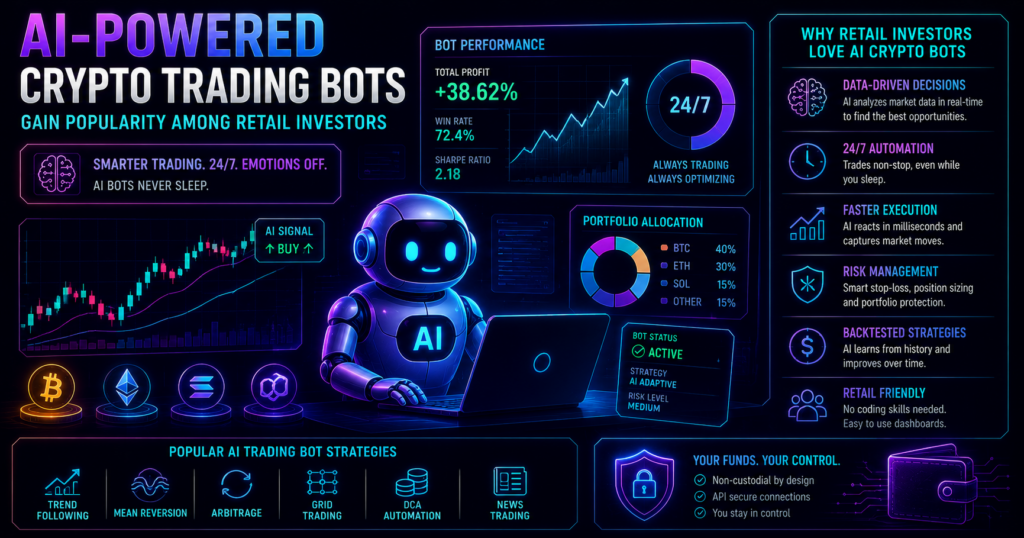
The article this replaces described AI crypto trading bots 2026 buyers might use, listed their advantages, and never once mentioned that the category is also one of the most active fraud vectors regulators track. That omission is not a minor gap. The tools are real and some are useful, but the same phrase sells both legitimate software and Ponzi schemes, and the difference is not visible in the marketing. Here is what the regulators have actually documented, and the four checks they recommend before you pay anyone. Key Takeaways The CFTC’s standing advisory is titled “AI Won’t Turn Trading Bots into Money Machines” and states plainly that AI cannot predict sudden market changes. Claims of high or guaranteed returns are identified by the CFTC as red flags of fraud, not as features. One case cited in that advisory involved more than $1.7 billion taken from at least 23,000 people using a bot that promised 10% monthly. The SEC filed a complaint in May 2026 over an alleged $12.3 million scheme built on claimed proprietary AI trading bots. Fees, spreads and subscription costs are the quiet drag on any legitimate AI crypto trading bots 2026 setup. What AI crypto trading bots 2026 vendors sell actually do Start with the honest version. Automated trading software connects to an exchange through an API key and executes rules you configure: grid strategies, dollar-cost averaging, rebalancing, stop-losses. That is real, it works, and it removes the need to watch a market that never closes. Where the “AI” label adds something genuine, it usually means the parameters adapt to conditions rather than staying fixed. Where it adds nothing, it is a marketing layer on a rules engine that has existed for a decade. Both are sold using the same three letters, which is the first problem with evaluating AI crypto trading bots 2026 vendors are selling. What the regulator actually says The CFTC’s Office of Customer Education and Outreach published a customer advisory on 25 January 2024 whose title is the argument: AI Won’t Turn Trading Bots into Money Machines. It remains the agency’s standing guidance. The advisory states that fraudsters exploit public interest in AI to promote automated trading algorithms, trade signal strategies and crypto arbitrage schemes promising unreasonably high or guaranteed returns, and that AI technology cannot predict the future or sudden market changes. Melanie Devoe, the office’s director, summarised it as telling investors to be wary of the hype. That applies to AI crypto trading bots 2026 marketing as squarely as it did when the advisory was written. Read that carefully, because it inverts the usual framing. Regulators do not treat a high advertised return as an aggressive claim to be discounted. They treat it as a marker of fraud. The case that shows the shape The advisory includes a case study worth knowing in detail. Over roughly three years, Cornelius Johannes Steynberg took more than $1.7 billion in bitcoin from at least 23,000 people through Mirror Trading International, using websites and social media accounts. The pitch was familiar. Entry from $100 in bitcoin, no trading experience required, and a proprietary bot promising at least 10% monthly, which is more than 200% a year. Referral bonuses for bringing in friends. Fake customer account balances generated using demo accounts so the dashboard looked healthy. In reality very little was traded. It operated as a Ponzi scheme, paying earlier investors with later deposits. Nearly 30,000 bitcoin were involved, worth about $1.7 billion at the time. The pattern continued into 2026 This is not historic, which matters for anyone assessing AI crypto trading bots 2026 offers today. In a complaint filed on 29 May 2026, the SEC accused Nathan Fuller of running a scheme through Privvy Investments that sold interests in a crypto arbitrage operation described as powered by proprietary AI trading bots, with promised returns of 40% to 50% within 30 to 45 days and in some cases more than 100% inside a month. Reported losses were around $12.3 million. Those are allegations rather than findings, and the case is ongoing. For scale on the wider category, the FBI’s Internet Crime Complaint Center recorded $20.877 billion in reported internet crime losses during 2025, of which complaints involving cryptocurrency accounted for $11.37 billion. The four checks the CFTC recommends The advisory lists four things to do before trusting money to a trading bot or signal provider, and they are more concrete than most consumer guidance. Research the background of the company or trader, and run a reverse image search on key personnel to verify they are real people. Check the age of the trading website’s domain registration, which takes seconds and frequently ends the conversation. Get a second opinion from a financial advisor or someone you trust before committing. And understand the risks of the underlying assets, including what fees, spreads and subscription costs would do to returns. That last point applies to legitimate products too, which is why it is the most useful of the four for anyone comparing AI crypto trading bots 2026 platforms honestly. A subscription fee plus exchange fees plus spread on every automated trade compounds against you continuously, and a strategy that looks marginally profitable before costs frequently is not after them. Our overview of crypto trading bots covers the platform landscape, and our guide to choosing a broker covers the venue underneath. One risk the old version understated Connecting any of the AI crypto trading bots 2026 platforms offer to an exchange means issuing an API key. Restrict it. Trading permissions only, never withdrawal permissions, and IP-restricted where the exchange supports it. A bot that requires withdrawal access is asking for the ability to remove your funds, and no trading strategy legitimately needs it. Disclaimer: This article is for informational and educational purposes only and is not financial or investment advice, and no platform or product is endorsed. Automated trading can lose money quickly, and no strategy or software produces assured returns. Enforcement matters described here are allegations unless
Predictive AI Crypto 2026: 3 Strong Use Cases and 6 SEC Warnings

Most writing about predictive AI crypto 2026 blurs three separate things into one. The software that analyses markets, the tokens that carry AI branding, and the marketing claims firms make about both. They have almost nothing to do with each other, and confusing them is expensive. One number makes the point. Since March 2024, the US Securities and Exchange Commission has brought six enforcement actions over what it calls “AI washing”, covering more than $44 million in alleged fraud. In the first of those cases, a firm had told investors its proprietary algorithms made predictions up to two years into the future. The SEC found it had never built the capability at all. This piece separates the three, sets out what predictive models genuinely do, and explains which distinction actually determines your risk. It assumes no technical background. Key Takeaways The SEC has brought six AI washing cases since March 2024, representing over $44 million in alleged fraud, and negligent misstatements are actionable without any proof of intent. Buying an AI-branded token automates nothing. The token sector and the trading software are unrelated purchases. The AI crypto token sector held roughly $21.25 billion across about 1,438 tokens in August 2026, down from a peak range of $22.6 billion to $27 billion in May. Virtuals Protocol, the largest agent launchpad, carried a market capitalisation near $5.01 billion in early 2026 and roughly $365 million to $410 million by early August. The risk difference between a bot and an agent is not intelligence. It is transactional authority, meaning whether the software can sign transactions on its own. Predictive AI Crypto 2026 Distinction One: Tools Versus Tokens This is the confusion that costs retail investors the most money, so it belongs first. “AI agent” means two unrelated things in crypto. The first is a category of software that analyses data, generates signals, or executes trades. The second is a sector of tradeable tokens issued by projects building agent platforms. Buying the second does not give you the first. Holding an AI-branded token automates nothing about your own trading. The sector numbers are worth knowing before anyone quotes them at you. The AI crypto category grew from roughly $9 billion at the start of 2025 to somewhere between $22.6 billion and $27 billion by May 2026, then contracted through the second half of the year to about $21.25 billion across roughly 1,438 tracked tokens in August 2026, on daily volume near $1.47 billion. Underneath that, dispersion has been severe. Virtuals Protocol, the dominant agent launchpad with around 14,000 agent tokens launched through it, carried a market capitalisation near $5.01 billion in early 2026. By early August 2026 that figure was roughly $365 million to $410 million. A Q1 2026 correction of about 16% across the sector fell heavily on tokens that had adopted agent branding without a working product. Our piece on the AI token narrative covers how that category behaves. Distinction Two: Rule-Based Bots Versus Autonomous Agents The second predictive AI crypto 2026 distinction determines your actual risk, and it is usually framed wrongly as a question of how clever the software is. A rule-based bot executes a fixed script. If price crosses a level, place an order. Its behaviour is fully predictable, which is both its limitation and its safety feature. An autonomous agent interprets context, decides what to do, and executes within delegated parameters, with no human step in between. The meaningful difference is transactional authority. Agents can hold assets and sign transactions independently, using wallet standards that grant session-based permissions without exposing private keys. That is a genuine capability gain and a genuine risk transfer. A bot that malfunctions does the wrong predictable thing. An agent that malfunctions does something nobody specified, with signing rights. For any assessment of predictive AI crypto 2026, that is the question worth asking about any tool: how much authority does it hold over real funds, and what are the hard limits. Not how advanced the model is. Our coverage of autonomous crypto agents goes into how these systems are structured. Distinction Three: Capability Versus Claim The third predictive AI crypto 2026 separation is between what a system does and what its marketing says it does, and here the evidence is unusually good because a regulator has been writing it down. The SEC opened its AI washing programme in March 2024 with simultaneous actions against two investment advisers, Delphia and Global Predictions. Delphia had claimed in press releases, website copy and its Form ADV brochures that proprietary algorithms made predictions across thousands of public companies up to two years ahead. The SEC found the firm had never developed those capabilities. Global Predictions had described itself as the first regulated AI financial adviser offering expert AI-driven forecasts. Neither firm admitted or denied the findings. Both were censured and agreed to cease-and-desist orders, with Delphia paying a $225,000 civil penalty and Global Predictions $175,000. Since then the programme has expanded. Six named cases have followed, including the first action against a public company in January 2025, covering more than $44 million in alleged fraud. The charges rest on existing antifraud provisions of the Investment Advisers Act and the Marketing Rule rather than any AI-specific statute, and the standard does not require intent, so negligent overstatement is enough. The SEC’s 2026 examination priorities include how firms represent AI capabilities and whether written policies govern AI use across trading and back-office functions. What Predictive Models Genuinely Do Having drawn the lines, the underlying capability is real and worth describing accurately. Predictive AI crypto 2026 systems combine price history, order book and liquidity data, on-chain activity such as wallet movements and transaction flows, and text-derived sentiment from news and social sources. The value is in the combination rather than any single input, because assembling that view manually in real time is not practical. Three applications hold up reasonably well. Pattern recognition across many assets at once, where a model surfaces relationships a person scanning charts would miss. Volatility and